Concept
Solar Calendar, Lunar Calendar, or Something Else? Getting Your Saju Date Right
One of the most common questions people have when preparing for a Saju (Korean Four Pillars astrology) reading is: 'Should I enter my solar birthday or my lunar birthday?' The short answer is that classical Four Pillars uses neither a strictly solar nor a strictly lunar calendar. It follows the solar-term calendar, which marks months by the sun's position along the ecliptic. Miss this distinction and your month or year pillar can end up completely wrong. Let's work through the principles step by step.
Four Pillars Uses Its Own Calendar
Two calendars dominate everyday life. The solar calendar tracks Earth's orbit around the sun. The lunar calendar follows the moon's phases.
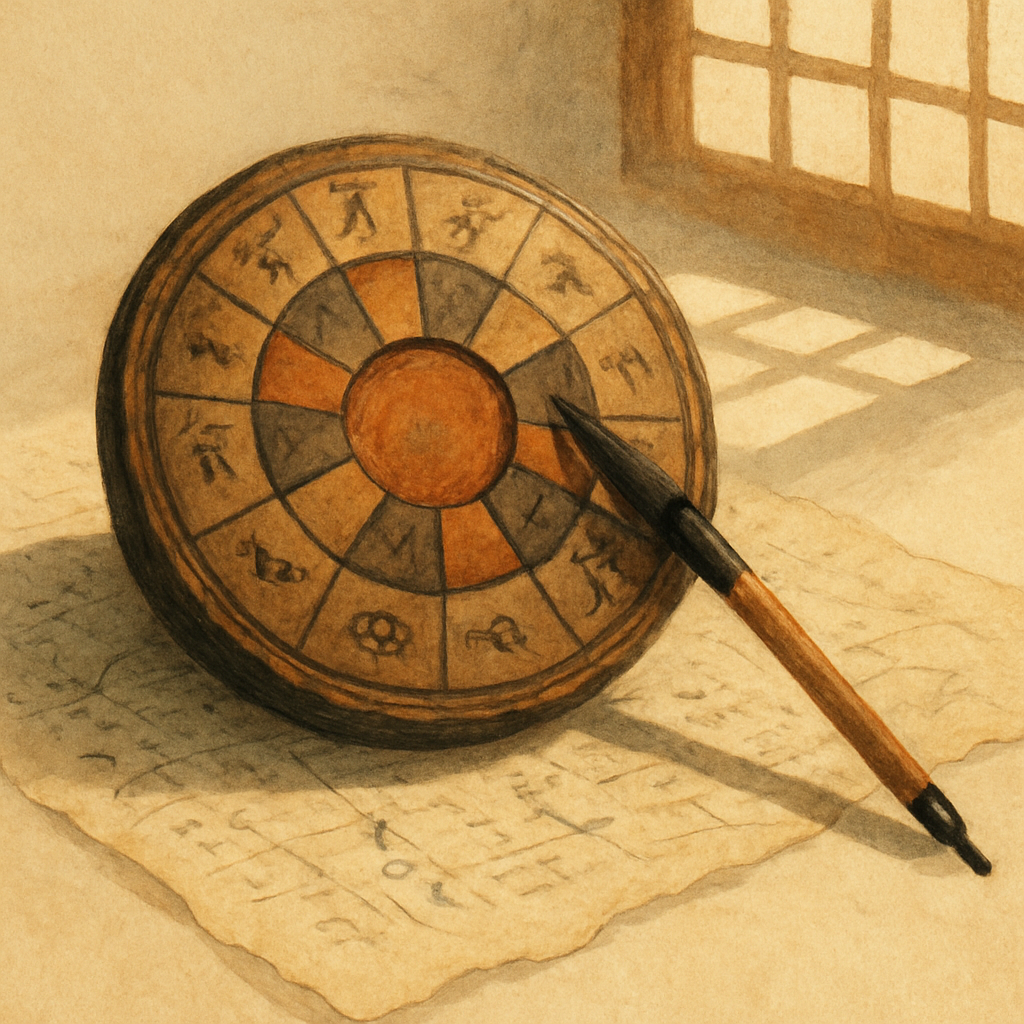
Four Pillars works with a third system: the solar-term calendar. Here, month boundaries are set by the exact moment the sun reaches a specific degree along the ecliptic (the apparent path of the sun across the sky). Of the 24 solar terms, the odd-numbered ones, called jieqi (major terms) in Chinese, are the ones that open each new month. In Korean these include Ipchun (start of spring), Gyeongchip (awakening of insects), and Cheongmyeong (clear and bright).
So when you look up a month pillar in the ten-thousand-year calendar (the traditional almanac used for Four Pillars), what matters is not which lunar month you were born in. What matters is which pair of solar terms your birthday falls between.
In short: month boundaries in Four Pillars are defined by solar terms. The solar and lunar calendars are simply tools for converting the date you know into the right input.
So Why Is the Solar/Lunar Question So Confusing?
In traditional Korean society the lunar calendar ruled daily life, so most older generations remember their birthday by the lunar date. Before hospital birth records were common, that lunar date was often the only record that existed.
Today the situation is reversed: national ID cards and birth certificates all use the solar calendar, so many people never learned their lunar birthday in the first place.
The key point is this: if you know your exact solar date, you can enter it into the ten-thousand-year calendar without any problem. The calendar will look up which solar-term interval that date falls in and assign the correct stem-branch characters from there.
In other words, the idea that 'entering a solar date gives you the wrong reading' is simply not true. What you do need to watch out for is accidentally converting a lunar date into the wrong solar date.
In short: enter whichever date you know accurately, solar or lunar. Just make sure you know which system your date comes from before you type it in.
Ipchun and When the Year Pillar Changes
The year pillar, which represents the stem-branch of your birth year, does not change on January 1. It changes at Ipchun (the start of spring), which usually falls around February 4 in the solar calendar.
For example, someone born on February 2 still carries the year pillar of the previous year. If Ipchun that year fell on February 4, then February 2 belongs to the previous year's cycle.
Overlooking this can shift your entire year pillar, which in turn can affect the ten-gods (the relational forces derived from your pillars) and the major-cycle calculations built on top of it.
Checklist for people born near Ipchun
- Born between January 1 and the day before Ipchun: use the previous year's pillar
- Born on Ipchun or after: use that year's pillar
- Born on the exact day of Ipchun: check the precise time of Ipchun in the ten-thousand-year calendar and compare it to your birth time
In short: if you were born in January or February, always verify the exact date and time of Ipchun for that year using a ten-thousand-year calendar.
The Jasi Boundary and When the Day Pillar Changes
The day pillar also needs care. In Four Pillars, the day changes at Jasi (the rat hour), which runs from 11 p.m. to 1 a.m.
If you were born after 11 p.m., the calendar date still shows the previous day, but by Four Pillars reckoning the next day's pillar has already begun.
Some schools divide Jasi into two halves: early Jasi (11 p.m. to midnight) and late Jasi (midnight to 1 a.m.), assigning different day pillars to each. This is known as the midnight-division method. Checking which approach your ten-thousand-year calendar follows before you start can save a lot of confusion.
In short: if you were born between 11 p.m. and 1 a.m., confirm how your ten-thousand-year calendar handles Jasi before settling on your day pillar.
What to Do If You Were Born in an Intercalary Month
The lunar calendar inserts an intercalary (leap) month roughly every two or three years, giving that year 13 months. People born in one of these extra months often wonder which month their reading should use.
Because Four Pillars runs on the solar-term calendar, the answer is straightforward: it doesn't matter that the month was intercalary. All you need to know is which solar-term interval that specific date falls in. An intercalary month does not generate its own separate month pillar.
For example, someone born in an intercalary fifth lunar month whose birthday falls between Mangzhong (Grain in Ear) and Xiaoshu (Minor Heat) will simply have the Horse month (the fifth solar-term month) as their month pillar. The intercalary designation has no effect on that assignment.
- If born in an intercalary month: convert the date to the solar calendar and enter it into the ten-thousand-year calendar
- Identify the solar-term interval that solar date falls in
- The intercalary label itself has no bearing on the month pillar assignment
In short: for intercalary-month births, find the solar date and match it to the correct solar-term interval. Your month pillar will follow naturally.
Choosing a Reliable Ten-Thousand-Year Calendar
Getting the stem-branch assignments right starts with using a trustworthy ten-thousand-year calendar. When evaluating one, consider the following.
- Does it list the exact date and time of each solar term for every year?
- Does it clearly state how it handles Jasi, including whether it uses the midnight-division method?
- Does it automatically convert intercalary-month dates to the solar calendar and display the corresponding solar-term interval?
- Does it cover births before 1900?
Once you have entered your birth details accurately, the next step is reading the flow of the present moment. Today's fortune uses your birth date and time to walk through both the day's energy and your current major-cycle trends.
Once you understand how the solar calendar, lunar calendar, and solar-term calendar relate to one another, you can cross-check results from any reading service on your own. Clearing up calendar confusion is the very first condition for an accurate Four Pillars reading.
Curious about today's energy? Check it now at Today's Fortune.