Practical
How to Navigate Samjae: From Protective Charms to the Right Mindset
There are moments when hearing the word Samjae makes you feel like you have to do something. The second a family member says 'this is your Samjae year,' small pieces of bad luck suddenly seem to connect into a pattern. This post brings together traditional protective practices and a grounded, practical mindset. We'll go through what tends to help, and what to be cautious of, step by step.
People Who Have Come to Us for a Reading
A woman in her mid-thirties, working a regular office job, came in after a difficult stretch: a failed job change, a minor car accident, and a family elder's health taking a turn for the worse, all in the same year. A friend had mentioned that it sounded like Samjae. She said she came because she wasn't sure whether to get a protective charm or arrange a ritual ceremony.
A man in his early forties, running his own small business, had a similar story. Revenue had been slipping, and when someone told him Samjae was overlapping with that period, he was then urged to pay for a large-scale ritual. He came in weighed down by indecision.
Both of them weren't really asking about Samjae itself. They were asking how to get through this stretch of time well. That question is where this post begins.
What Is Samjae: A Quick Three-Minute Overview
Samjae (三災, literally 'three calamities') refers to a three-year period of unsettled energy that cycles around every twelve years. Zodiac signs are grouped in sets of three, and when a group's years arrive, Samjae begins for those signs.
- Entering Samjae (the first year): Samjae begins. Change and friction tend to arise more easily.
- Middle Samjae (the second year): The midpoint. Energy is often at its most suppressed during this phase.
- Departing Samjae (the third year): The final year. The energy gradually begins to recover.
Some people treat Samjae as purely negative, but within Saju (Korean Four Pillars astrology), it's more accurately read as a period to strengthen foundations rather than push for expansion. Check the Samjae and bad luck page first to see whether this period applies to you and how it might play out.
In short: Samjae is a three-year energy pattern, not a guaranteed stretch of misfortune. It's a signal to pause, review, and recalibrate.
Traditional Protective Practices: What's Actually Out There
Traditional Korean practice offers several approaches. There's no obligation to do all of them. Choose what genuinely brings you a sense of calm.
Using a Protective Charm
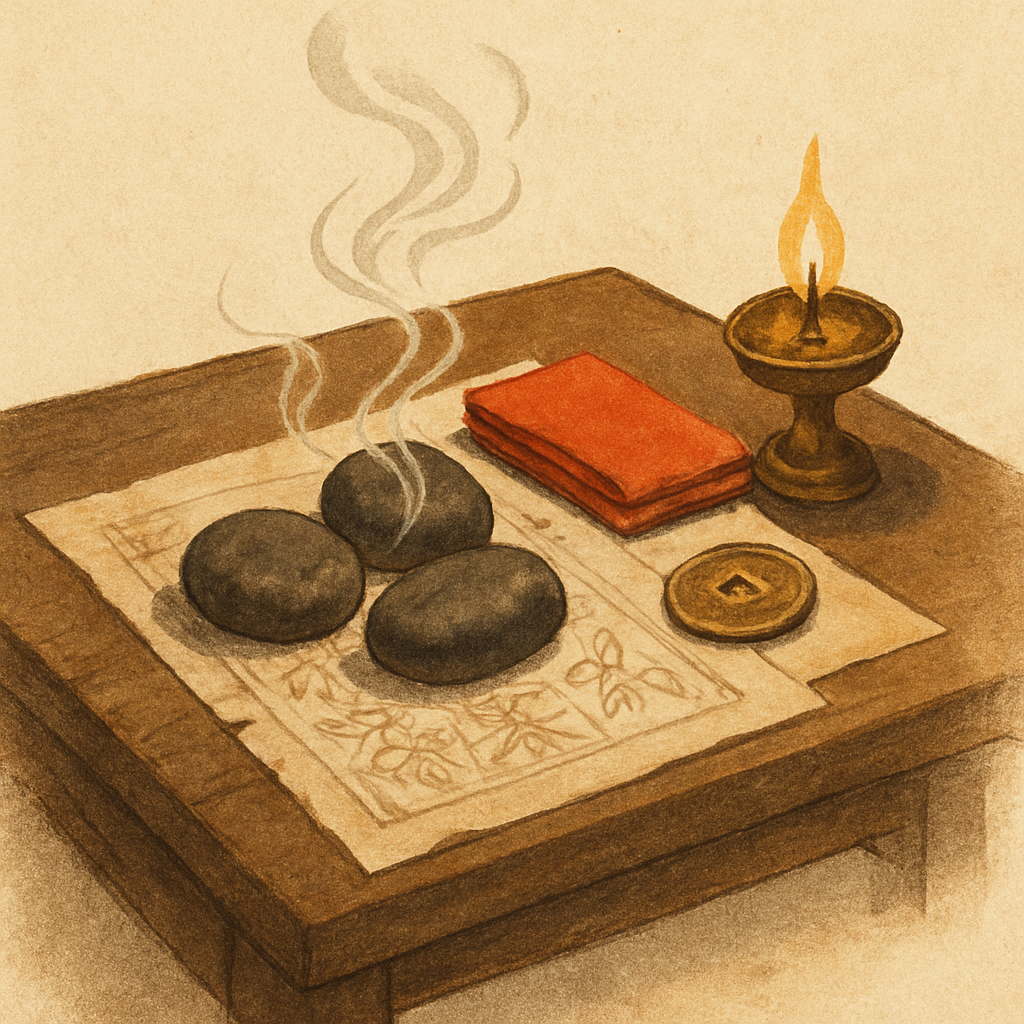
A Samjae charm (bujok) is a piece of paper bearing a symbol or inscription meant to ward off the period's unsettled energy. Traditionally, charms written in red are carried on the body or placed above an interior door. Receiving one from a reputable Buddhist temple or a trusted divination practitioner is the common approach. If someone is pushing an unusually expensive charm, it's worth pausing to think twice.
Working with Direction and Color
During Samjae, there's a long-standing tradition of choosing moving or renovation directions with extra care. There's also a custom of keeping red-toned undergarments or small accessories nearby. In the Five Elements (오행, ohaeng) framework, red belongs to Fire, which is traditionally seen as a force that repels negative energy.
Ritual Ceremonies: How to Decide
Some practitioners recommend a gut (Korean shamanic ritual) or a larger ceremonial rite. There's nothing wrong with such practices in principle, but if the cost runs well into the hundreds of thousands of won, or if you're being told something along the lines of 'skip this and something terrible will happen,' that's a reason to be careful. Samjae describes a possible tendency in your energy flow. It doesn't mean something bad will definitely occur.
In short: charms, directional choices, and color customs are tools for inner steadiness. Think carefully before spending heavily on a ceremony.
Everyday Habits You Can Start Right Now
Separate from traditional practices, there are daily habits that can genuinely help you feel less rattled during Samjae. These are suggestions that come up often in actual fortune-telling consultations.
- Hold off on major decisions: Starting a business, changing jobs, signing a property contract. Choices that are hard to reverse can often wait until after the Samjae period.
- Review your finances: Samjae can be a good time to simplify spending and build up a cushion. Cutting back on impulsive large purchases tends to help.
- Build a health routine: Some people find their stamina and immunity feel more vulnerable during Samjae. Start by looking at sleep and eating patterns.
- Simplify your relationships: Many people notice friction in certain relationships during this period. It may be worth stepping back from interactions that consistently drain your energy.
- Keep a gratitude record: When your attention naturally drifts toward setbacks, writing down small positive moments can shift the way you perceive the overall flow.
In short: getting through Samjae well doesn't require anything dramatic. The core is simple: slow down, take stock, and build from the inside out.
Shifting Your Perspective: Samjae as a Season of Care
If you approach Samjae as a curse to outrun, three years can fill up with anxiety. If instead you treat it as a valid reason to ease off the accelerator, you may find that it actually opens up some breathing room.
In Saju, the zodiac signs going through Samjae are often in the middle of one of the biggest energy transitions in the twelve-year cycle. Rather than pushing hard for results and risking a collapse, a strategy of consolidating your foundation and preparing for the nine years ahead tends to serve people much better.
Charms and rituals are tools that can help you feel ready. Use them if they help, but the real work of getting through Samjae is keeping your own decisions and habits intact rather than outsourcing everything to external remedies. Before turning to charms, understanding your own Saju energy pattern can be a useful starting point. Reading about charms and protective symbols is also worth your time.
In short: Samjae isn't a curse to block. It tends to work better when received as a signal to slow down and look inward.
Reading Samjae Alongside Your Personal Saju Chart Brings It Into Focus
Samjae gives a broad picture based on zodiac sign groupings, but when it overlaps with an individual's Saju chart, major luck cycles (daewoon), and annual energy (sewoon), the experience can vary enormously from person to person. Some people have their most expansive periods during Samjae. Others find the departing year the hardest.
When you look at your favorable element (yongsin) and unfavorable element (gisin) structure alongside this year's annual energy, it becomes much clearer which stretches within Samjae call for extra care and which ones may actually be fine for moving forward.
Sajagung's Samjae and bad luck service covers everything from checking whether Samjae applies to you, to reading how it interacts with your luck cycles and annual energy, to suggesting protective directions suited to your personal situation. It's useful for anyone who wants to feel less unsettled, or who wants a clearer strategy for this period.
Reading Samjae alongside your personal Saju chart can give you a much clearer sense of when to be careful and when it may be fine to act.