Concept
I Ching Divination vs. Saju: Why the Same Question Gets Two Different Answers
Have you ever brought the same worry to a Saju reading and an I Ching divination, only to get two different answers? That does not mean one of them was wrong. Saju and I Ching divination simply work along different axes of time. Once you understand which tool to reach for and when, you can get far more out of both.
Two Tools That Answer Two Different Questions
The biggest reason people confuse Saju and I Ching divination is that both carry the impression of "seeing what lies ahead." In practice, though, the two tools start from entirely different places.
Saju is built from the year, month, day, and hour of birth, the four pillars. Because it is rooted in a fixed moment in time, a chart can be drawn up without any question at all. I Ching divination, on the other hand, cannot begin without a question asked in this very moment.
Put simply: Saju asks "what is the grain of this person's life," while I Ching divination asks "how should I move in this situation, right now."
Saju: Reading a Lifelong Map
Saju (Four Pillars astrology) analyzes how the five energies, Wood, Fire, Earth, Metal, and Water, are arranged across the heavenly stems and earthly branches of the birth moment. This arrangement forms a person's fundamental constitution and serves as a background map for life.
By layering in the Daewoon (ten-year luck cycle) and Sewoon (yearly luck cycle), a reader can trace how these energies shift decade by decade and year by year. It is a way of reading the flow: at which periods major events such as finding work, marriage, or a career change tend to become more possible.
- Analysis is possible from the birth chart alone, without any question
- Long-term patterns can be traced through ten-year Daewoon and yearly Sewoon cycles
- Can illuminate a person's temperament, vocational fit, and relationship patterns
- Because the original chart never changes, readings remain consistent across multiple consultations
Put simply: Saju is the tool to reach for when you want to understand what kind of current is coming, and roughly when.
I Ching Divination: An Answer Offered in This Moment
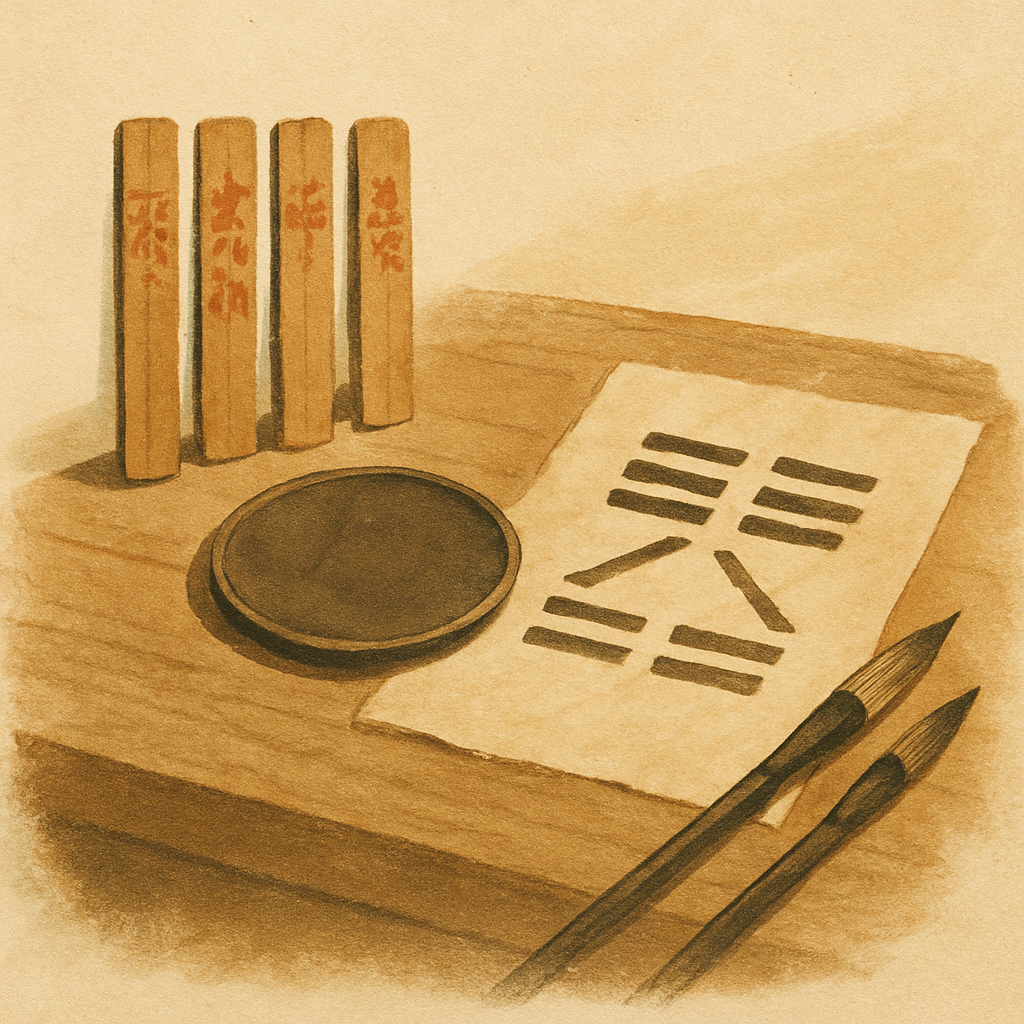
I Ching divination reads the dynamics of a querent's present situation through 64 hexagrams and 384 individual lines. The physical act of casting coins or yarrow stalks is understood to reflect the querent's energy at this moment.
The heart of I Ching divination is the changing line, or byeonhyo. By observing which hexagram the current one transforms into, a reader can sense the direction a situation may be moving. Rather than fixed fate, it points toward a current that can shift depending on the attitude you take right now.
- A clear, specific question must be formed before casting
- Even for the same person, a different question or a different moment will produce a different hexagram
- Particularly useful for near-term decisions, choosing a direction, and checking timing
- Works well for examining specific choices within the broader current already identified through Saju
Put simply: I Ching divination is the tool to reach for when you need to check whether this particular decision is all right to make right now.
Two Tools on Different Time Axes: How to Tell Them Apart
Thinking about time makes the difference clear. Saju is a long line that begins at birth and extends forward. I Ching divination is closer to a compass that scans 360 degrees from the single point of the present moment.
If Saju is a topographic map, I Ching divination tells you which direction you are facing from where you stand right now.
So when the same career-change worry is brought to both tools, Saju might reveal "a period when the energy around career and authority tends to strengthen, making a professional shift more likely in the second half of this year," while I Ching divination might address "whether moving to this specific company that has just made an offer fits the current flow."
Put simply: Saju speaks to current, I Ching divination speaks to timing. The two tools are not rivals; they are partners with different roles.
How to Use Saju and I Ching Divination Together
There is a practical sequence that tends to work well when using both tools together. Start with Saju to get a sense of the broad current for this year or next. Then, as a specific decision point approaches within that current, use I Ching divination to check the finer direction.
Try this sequence
- Step 1: Use Saju to understand the nature of this period (expansion, consolidation, or transition)
- Step 2: Before a major decision, check whether your choice tends to run with or against the current shown in Saju
- Step 3: Just before committing, use I Ching divination to examine the possibilities and cautions around this specific action right now
- Step 4: Use the guidance from the hexagram as a practical checklist during the execution phase
Even if Saju suggests that a career-change current is coming, I Ching divination may indicate that waiting a little longer could be more favorable at this particular moment. In that case, the reading is not a signal to abandon the idea of changing jobs entirely; it is better read as a nudge to fine-tune the timing.
Put simply: a practical approach is to use Saju for the broad current and I Ching divination for the precise moment of decision.
If You Need to Decide Right Now, Start with I Ching Divination
If you do not have a Saju chart, or if you already have a sense of the bigger picture and are simply standing at a decision point right now, I Ching divination can offer a more direct answer.
When casting, it matters to form the question as concretely as possible. A question like "Is it all right to move forward with this contract within this month" tends to call up a far clearer hexagram than something vague like "what will my future be like." Questions that include a specific action and a specific timeframe work best.
The key is not switching between tools arbitrarily, but choosing the tool that fits the size of the question and the timeframe involved.
Sajagung's I Ching divination readings provide both a hexagram interpretation suited to the querent's situation and a reading of the changing lines. If you are not sure how to form your question, you are welcome to simply bring your worry as it is.
If you are standing at a decision point right now, try I Ching divination to check the current of this moment first.