Practical
How to Cast an I Ching Reading: Finding Today's Answer with Three Coins
You know that feeling of lying awake because a decision could go either way, and both paths seem equally right? I Ching divination (the ancient Chinese oracle known in Korea as Juyeok) can help you hear your own inner voice more clearly in exactly those moments. All you need is three coins and a sheet of paper.
The Kinds of People Who Come Looking for an I Ching Reading
Not long ago, a man in his mid-thirties came in for a consultation. He had received a job offer with a good salary and an appealing role, yet for some reason he could not bring himself to say yes. After we finished his Saju (Korean Four Pillars astrology) reading, he asked almost in passing, 'Could we also try an I Ching reading?'
Another visitor was a woman in her early forties. She had fallen out with a long-time friend and had spent months unable to decide whether to reach out first or wait. What both of them wanted was not really to find an answer they didn't know. They wanted to confirm which answer already felt closest to their own heart.
That is exactly where an I Ching reading shines. It doesn't make the decision for you. It acts more like a mirror, reflecting the current shape of your situation through one of 64 hexagrams.
What You Need, and How to Settle Your Mind Before You Begin
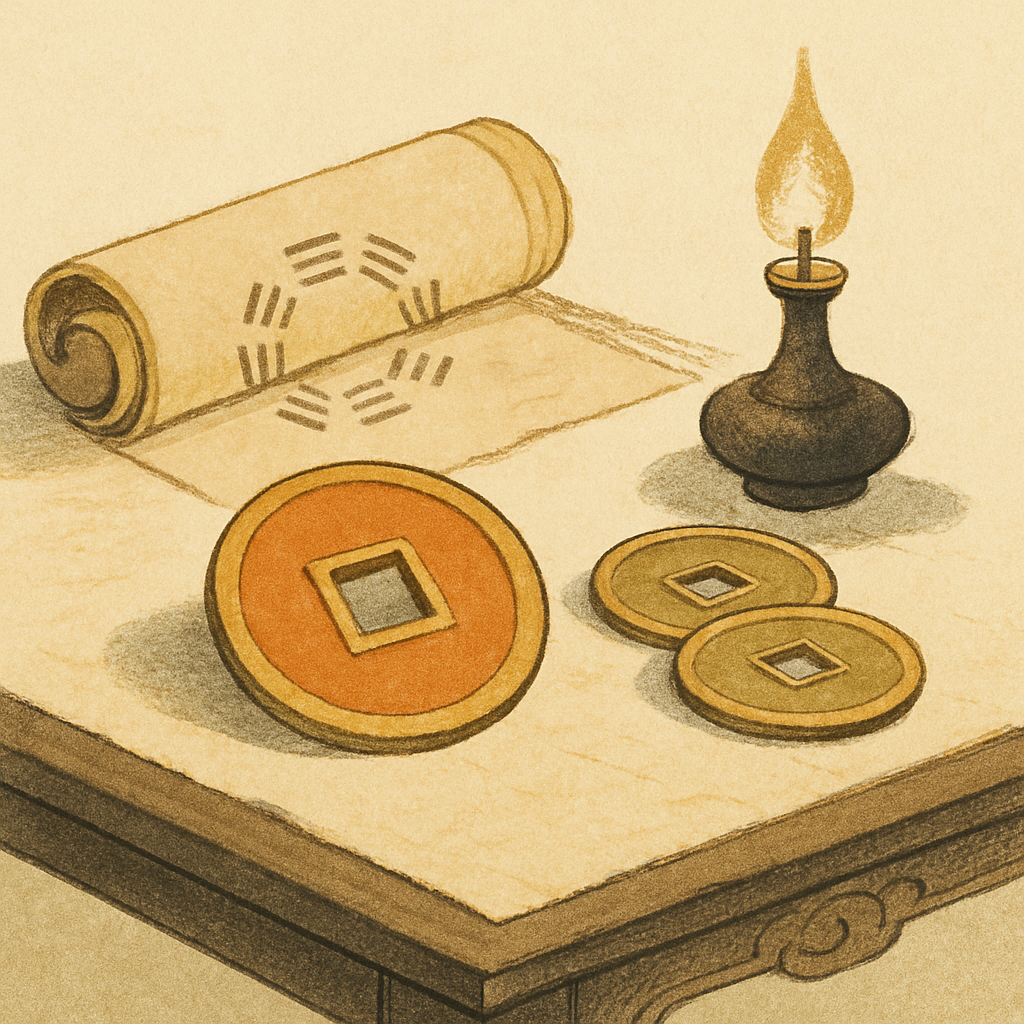
The supplies for an I Ching reading are wonderfully simple: three identical coins, a pen and paper to record the hexagram, and about ten quiet minutes.
Refine your question before you toss a single coin
A yes-or-no question like 'Should I change jobs or not?' tends to produce a flat reading. Something more open, such as 'What kind of energy or direction might unfold for me if I choose to change jobs?' invites a much richer answer. The more specific your question, the clearer the hexagram's guidance tends to be.
- Stick to one question, and keep it short and clear.
- Questions that begin with 'How' or 'In what direction' tend to work well.
- Before tossing the coins, close your eyes for a moment and repeat the question to yourself three times.
- If you have been drinking, have just eaten a large meal, or feel extremely agitated, take a little time to settle before you begin.
How to Build a Hexagram: Three Coins, Tossed Six Times
The heart of an I Ching reading is a simple process: toss all three coins together six times to generate six lines (in Korean, each line is called a hyo, from the Chinese character 爻). Those six lines, stacked one on top of another, form a complete hexagram.
Turning the toss into a line value
Assign the face side of each coin a value of 3 (yang) and the tail side a value of 2 (yin). Add the three coins together to get the line type.
- Total 6 (three tails): Old Yin, a broken line (- -). This is a changing line and will transform.
- Total 7 (one face, two tails): Young Yang, a solid line (--). This line stays fixed.
- Total 8 (two faces, one tail): Young Yin, a broken line (- -). This line stays fixed.
- Total 9 (three faces): Old Yang, a solid line (--). This is a changing line and will transform.
Place your first toss at the bottom (the first line) and your sixth toss at the top (the sixth line). In the I Ching, you always build and read upward from the bottom.
Reading the Flow: Two Maps, the Base Hexagram and the Derived Hexagram
Once your six lines are in place, you will have two hexagrams to work with. The base hexagram (bon-gwe in Korean) shows where things stand right now. The derived hexagram (byeon-gwe) shows the direction in which the situation may be moving.
How you read changes depending on how many changing lines appear
- No changing lines: Focus on the overall hexagram statement (the gwasa) of the base hexagram. This can be a sign that the situation is relatively stable right now.
- One or two changing lines: Start with the individual line statements (hyosa) for those lines, then read the base and derived hexagrams together to follow the arc.
- Three or more changing lines: Give equal weight to the statements of both hexagrams, and pay close attention to the energy of transition.
- All six lines changing: Anchor your reading in the derived hexagram's statement. The situation may be in the middle of a thorough shift.
Think of the base hexagram as asking 'Where am I standing right now?' and the derived hexagram as asking 'Where is this current moving?' They are two mirrors held up at once.
Each of the 64 hexagrams carries a hexagram statement and six individual line statements. When you are starting out, keep a reliable I Ching commentary beside you and read slowly. You can also explore an I Ching consultation at Sajagung, where we work through the hexagram together with you.
A Better Question Brings a Better Answer
In an I Ching reading, the quality of your question matters more than any skill in interpretation. A vague question tends to produce a vague reading.
Try questions like these
- ✗ 'Will things work out between me and this person?' → ✓ 'What currents should I be aware of if I choose to continue this relationship?'
- ✗ 'Will my new business succeed?' → ✓ 'What kind of preparation might serve me best if I go ahead with this business direction?'
- ✗ 'Am I right, or is the other person right?' → ✓ 'What might I be missing in this conflict?'
The I Ching is, at its core, a book about change. It doesn't hand you a fixed answer. It reads the current momentum of a moment and suggests a direction worth considering. A reading doesn't take your decision away from you. If anything, it helps you claim that decision more fully as your own.
The Reading Is a Mirror. The Choice Is Always Yours.
Many people say they feel calmer after an I Ching reading. Not because the hexagram gave them the answer they were hoping for, but because the act of working through it helped them find an answer that was already inside them.
The man who was weighing the job offer looked at his hexagram and said, 'I think I already wanted to go.' The woman wondering about her friendship said, 'I knew reaching out first was right. I think I just needed permission.' The I Ching can create the space for you to give that permission to yourself.
A reading does not pronounce your fate. It reflects the shape of this moment and invites you to think alongside it about what kind of choice might suit you.
If you have already drawn your hexagram with three coins and would like to explore it more deeply, Sajagung's I Ching consultations are here for exactly that. We read the base and derived hexagrams together in the context of your specific question. Whether the hexagram still feels a little unfamiliar or you are simply standing in front of a difficult fork in the road, feel free to come and knock.