Concept
Moving Lines in the I Ching: Reading the Signal from Present Hexagram to Changing Hexagram
When you receive a hexagram from the I Ching (the classic Chinese Book of Changes), that hexagram may not be the whole story. Some lines rest quietly in place, while others quietly shift their nature and hint at the scene to come. A moving line, dong yao, works like a compass pointing to where the present situation is heading. Let's explore how to read that subtle space between the present hexagram and the one it becomes.
What Moving Lines Are, and Why They Matter
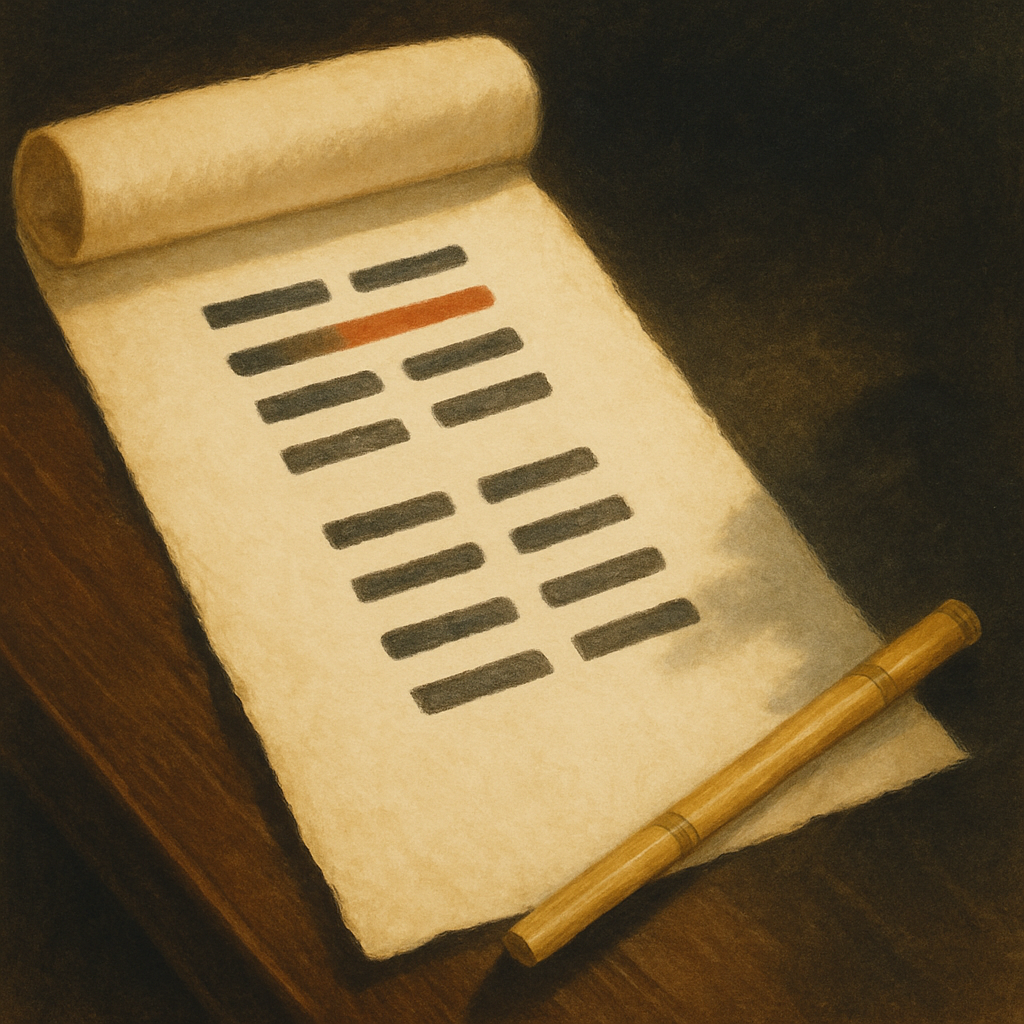
In the I Ching, each hexagram is made up of six lines. Every line is marked as either a yin line (broken, --) or a yang line (solid, -). Among these, any line that carries the potential to change is called a moving line, or dong yao.
When casting a hexagram using yarrow stalks or coins, each line is assigned a number. A six becomes old yin (lao yin), and a nine becomes old yang (lao yang). Only these two are moving lines. A seven is young yang (shao yang) and an eight is young yin (shao yin). These two stay put and do not change.
The word "old" is already a clue. Something has ripened as far as it can go and can no longer hold its present form. Just as a flower falls of its own accord when spring draws to a close, a moving line signals the passage into the next season. That is the essential nature of the dong yao.
Old yang carries yang energy, yet it transforms into yin. Old yin carries yin energy, yet it transforms into yang. When anything reaches its furthest extreme, it turns back. That is the foundational principle of the I Ching.
What Each of the Six Line Positions Brings to a Moving Line
The six lines stack from bottom to top in this order: first line, second, third, fourth, fifth, and top line. The character of a moving line's signal shifts depending on which position it occupies.
The lower three lines: movement within the inner trigram
- First line: the beginning of a matter, or a change at the most foundational level. A signal that the ground beneath something may be shifting or being newly laid.
- Second line: the most stable, centered position in the inner trigram. A moving line here often points to a transition in everyday, close-to-home concerns.
- Third line: the boundary between inner and outer. Because this position is inherently unsettled, a moving line here can carry a sense of in-between tension.
The upper three lines: movement within the outer trigram
- Fourth line: the opening of the outer trigram. Change may be beginning in the wider world, an organization, or one's broader environment.
- Fifth line: the center of the outer trigram, traditionally the ruler's position. A moving line here often reflects a shift in the central theme of the situation.
- Top line: the position of completion. When this line moves, it can signal that one full cycle is closing and an entirely different phase is about to begin.
Reading the Present Hexagram and the Changing Hexagram Together
Whenever at least one moving line is present, flipping the yin or yang of that line produces a new hexagram. This is the changing hexagram (bian gua). If the hexagram you first received is the present hexagram (ben gua), then the changing hexagram shows the next scene the situation may move toward.
The present hexagram reveals the current energy and the nature of the circumstances. The changing hexagram shows where that energy may be heading. If you were to join both into a single sentence, it might read: "Because things stand this way right now, there is a possibility that this kind of situation will unfold ahead."
When you receive a hexagram through I Ching divination, not stopping at the present hexagram but also considering the changing hexagram is the beginning of a fuller, more layered reading.
When There Are No Moving Lines, the Stillness Is Also a Message
If all six lines are young yang (seven) or young yin (eight), there are no moving lines at all. This is called a still hexagram (jeong gua, a stable cast).
No moving lines means there is no signal of change. The structure of this very moment is itself the answer. The reading centers on the hexagram's statement (gua ci, the overall text for the hexagram) and its image (xiang). Like a surface of water with not a breath of wind, the undisturbed present becomes the heart of the interpretation.
A still hexagram does not mean there is nothing to say. It can just as well be received as a message that maintaining the current state is in keeping with how things are naturally flowing.
When Several Lines Move at Once: How to Identify the Leading Line
When two or more lines move simultaneously, it becomes necessary to determine which line to center the reading on. Traditional practice offers the following guidelines.
- One moving line: center the reading on that line's text (yao ci, the statement for that specific line).
- Two moving lines: consider both lines, but treat the upper one as the primary line.
- Three moving lines: read the statement of the present hexagram alongside the statement of the changing hexagram and compare them.
- Four moving lines: shift focus to the two lines that did not move, the still lines (jing yao), and center the reading on those.
- Five moving lines: center the reading on the single line that did not move and its statement.
- All six lines moving: for the hexagrams Qian (Heaven) and Kun (Earth), use the special use-line (yong yao) designated for each. For all other hexagrams, read from the statement of the changing hexagram.
These guidelines vary somewhat from one school of I Ching study to another, so rather than applying them rigidly, it tends to work better to use them flexibly within the broader flow and context of the reading as a whole.
Developing an Eye for the Shape of Change: A Closing Reflection
A moving line is not simply a mechanical signal that says "this line changes." It is a tool for sensing, through the position and nature of the line, at which level of your situation a ripening energy may be at work.
The movement from present hexagram to changing hexagram, the quiet of a reading with no moving lines, the question of which line to lead with when several move at once: all of these point toward one large question. "Where is this situation heading?" The I Ching does not answer with certainty. It answers by showing you the landscape of possibilities.
If you would like to see firsthand how a single moving line can change the face of a hexagram, try casting one through I Ching divination. The present hexagram, the changing hexagram, and the position of the moving lines will all be laid out for you.
A hexagram is less like a photograph of a single moment and more like a short film that holds a movement in time. The moving line is the cut where the next scene begins.