Concept
An Introduction to the 64 Hexagrams: How the Eight Trigrams Unfold into a Map of Change
The I Ching (Zhouyi, the classic Chinese Book of Changes) is far more than a divination manual. It is a map of wisdom that compresses the patterns of natural change into 64 distinct scenes. The 64 hexagrams are the coordinates you use to read that map. Here we walk through how the eight trigrams expand into 64 hexagrams, what situation each hexagram captures, and how to approach them in order.
Why 64 Hexagrams: Capturing Change in Numbers
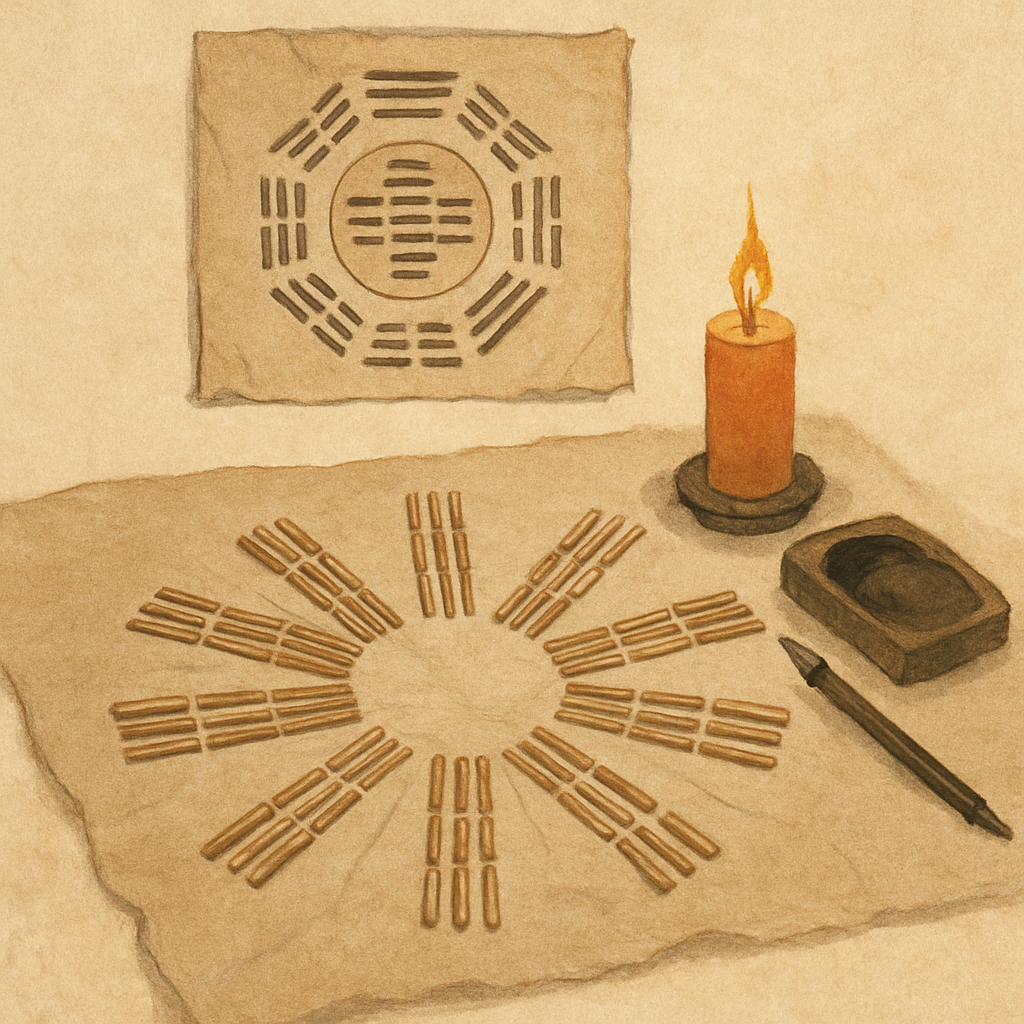
The I Ching begins with just two lines: yin and yang. Stack either line three times and you get 2 cubed, eight possible combinations. Those eight combinations are the trigrams (the eight trigrams, or bagua in Chinese).
Place any trigram on top of any other and you get 8 times 8, a total of 64 combinations. That is the structure of the 64 hexagrams: nearly every pattern of change found in nature and human life, sorted into 64 scenes.
Two lines give rise to eight scenes, and those eight scenes meet one another to unfold sixty-four kinds of change.
The logic in brief: yin and yang (2) produce the eight trigrams (8), which in turn produce the 64 hexagrams. Grasping this numerical structure first makes the whole system much easier to see.
Eight Faces of the Trigrams: Learning Through Natural Images
Each of the eight trigrams carries layered associations: natural phenomena, directions, parts of the body, family roles, and more. Rather than trying to memorize them outright, it helps to connect each trigram to a vivid image first. That approach tends to work much better for beginners.
- Qian (heaven): sky, strength, the father. All three lines are yang.
- Kun (earth): ground, receptivity, the mother. All three lines are yin.
- Zhen (thunder): thunder, movement, the eldest son. One yang line below, two yin lines above.
- Xun (wind): wind, penetration, the eldest daughter. One yin line below, two yang lines above.
- Kan (water): water, sinking, the middle son. One yang line in the center, yin lines above and below.
- Li (fire): fire, brightness, the middle daughter. One yin line in the center, yang lines above and below.
- Gen (mountain): mountain, stillness, the youngest son. One yang line on top, two yin lines below.
- Dui (lake): lake, joy, the youngest daughter. One yin line on top, two yang lines below.
In brief: the eight trigrams are eight natural images. Get those images into your hands before you try to interpret the 64 hexagrams, and the reading process will come much more naturally.
Upper and Lower Trigrams: How the 64 Hexagrams Are Built
Each of the 64 hexagrams is made up of six lines (called yao in Chinese). The bottom three lines form the lower trigram (also called the inner trigram), and the top three lines form the upper trigram (also called the outer trigram).
The lower trigram points to the inner situation: your own state, what is happening inside. The upper trigram points to the outer environment: the other party, external circumstances, or the likely outcome. The meaning of each hexagram emerges from how those two trigrams relate to each other.
Example: Hexagram 5, Xu (Waiting)
Lower trigram: Qian (heaven). Upper trigram: Kan (water). The image is water gathering above the sky. This hexagram is read as a scene of patient waiting and the ability to act at the right moment. When you bring the two natural images together, the core situation of the hexagram tends to reveal itself on its own.
In brief: lower trigram (self, inner situation) plus upper trigram (environment, outer situation) creates the distinct meaning of each of the 64 hexagrams.
A Taste of the First Six Hexagrams: Why the Order Matters
The sequence of the 64 hexagrams is not random. It follows a narrative arc: heaven and earth open, the ten thousand things are born, and they grow. Reading the first six hexagrams gives you the seed of that whole unfolding.
- Hexagram 1, Qian (heaven): pure yang energy, the potential for creation and new beginnings.
- Hexagram 2, Kun (earth): pure yin energy, the foundation of receptivity and continuity.
- Hexagram 3, Zhun (sprouting): the difficulty right after birth, like a seedling pushing through hard ground.
- Hexagram 4, Meng (youthful inexperience): the darkness of an early stage, a time when learning is needed.
- Hexagram 5, Xu (waiting): building capacity and waiting for the right moment.
- Hexagram 6, Song (conflict): disagreement and tension, the scene that can appear when communication breaks down.
If one of these six hexagrams comes up when you first try I Ching divination, it can help to ask yourself which phase you are currently in: beginning, confusion, waiting, or conflict.
In brief: the first six hexagrams sketch an opening story of creation, chaos, waiting, and conflict. Understanding that arc tends to make the remaining 58 hexagrams easier to interpret.
A Step-by-Step Learning Path for Beginners
Trying to memorize all 64 hexagrams at once leads to burnout quickly. Working through the steps below lets you build a solid foundation at a manageable pace.
- Step 1: Get comfortable with the natural images and basic qualities of the eight trigrams.
- Step 2: Learn to read the line structure, distinguishing yin lines from yang lines, and the first line (bottom) from the sixth line (top).
- Step 3: Practice combining upper and lower trigrams to construct hexagrams yourself.
- Step 4: Work through hexagrams 1 to 10, linking one short keyword to each.
- Step 5: Bring a real question and draw a hexagram through I Ching divination, then compare the hexagram text and moving lines to your situation.
Give each step enough time before moving on. Step 5 in particular tends to absorb meaning much faster when you have a genuine question in mind.
Checkpoint: if you can call up all eight trigram images from memory without looking, you are ready to move on to Step 2.
Curious About Your Current Situation: Try an I Ching Reading
Once the concepts behind the 64 hexagrams make sense, the next thing you need is the actual experience of drawing a hexagram. Reading about the I Ching in a book and going through the process of posing a real question and interpreting the result are two very different kinds of depth.
If you are facing a decision or simply want to get a clearer sense of where things are heading, Sajagung's I Ching divination can help you work through the current flow. We draw on the full 64-hexagram structure to lay out the relevant hexagram text and any changing lines for your situation.
The I Ching is not a book that hands you answers. It is a mirror that shows you which scene you are standing in right now.
Once the introductory concepts have settled in, bring a real question and visit I Ching divination. That meeting point between concept and lived experience is where the I Ching tends to become genuinely useful.