Concept
What Is Zi Wei Dou Shu: A Life Map Written in Stars
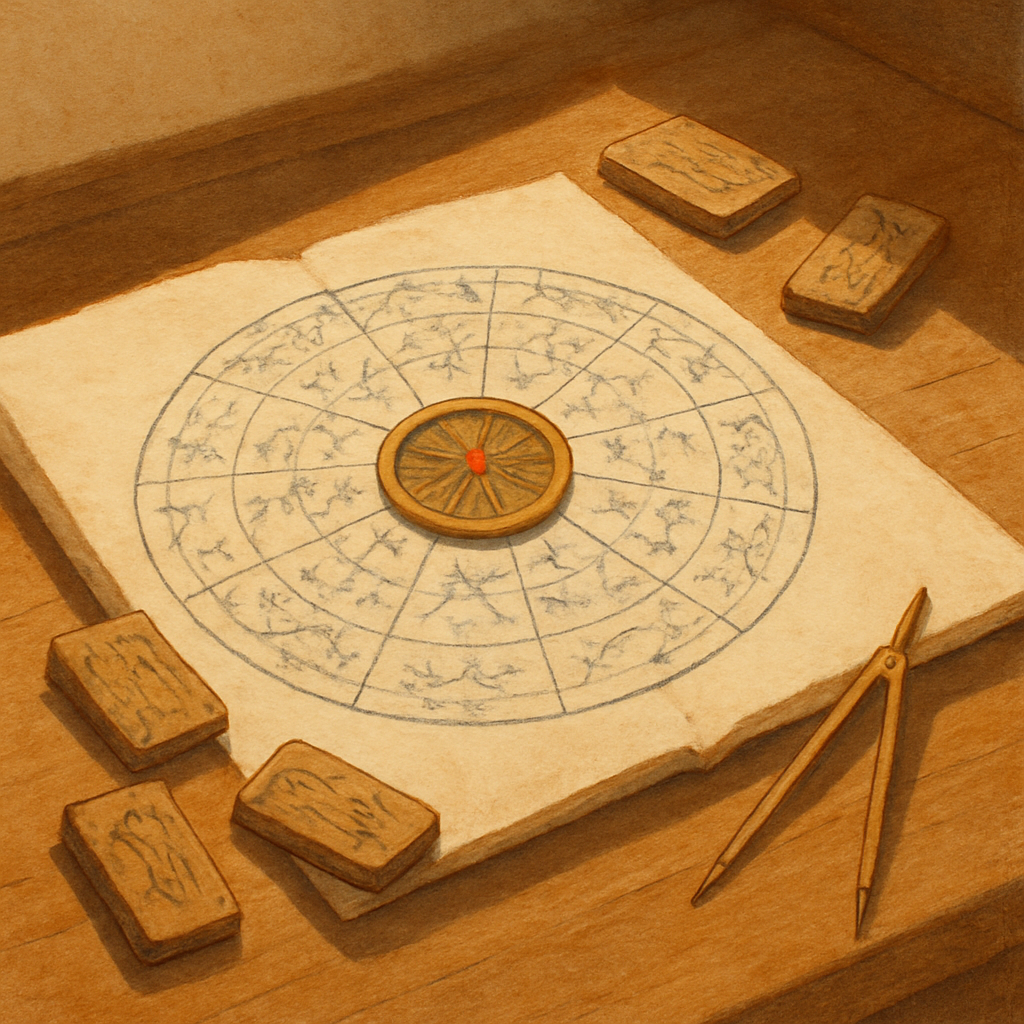
For a very long time, the stars overhead have served as a mirror reflecting the turns and tides of human life. Among the classical arts of East Asian divination, the one that has tried most carefully to read those stars is Zi Wei Dou Shu (Purple Star astrology). Where Saju reads the flow of time through combinations of heavenly stems and earthly branches, Zi Wei Dou Shu spreads the star positions at the moment of birth across twelve houses to draw a complete life map for one person.
Why Read Destiny Through the Stars
Every era has had its own tools for understanding fate. Some people read the lines on a palm; others interpreted the language of dreams. Zi Wei Dou Shu takes a different approach: it calculates the positions of stars with care and lays out an entire life on a single chart called a mingpan (life chart).
What makes this approach interesting is that meaning comes not from a single number or symbol but from the relationships and positions of the stars relative to one another. Think of an orchestra: it is not one violin alone but the arrangement of every instrument together that gives a piece its character. In the same way, a Zi Wei Dou Shu chart is less about any individual star and more about which house each star occupies and how they interact.
Origins: A Long Lineage Beginning with Chen Xiyi of the Song Dynasty
Zi Wei Dou Shu traces its origins to Chen Xiyi, a Taoist master who lived during China's Song dynasty. Chen Xiyi was known for retreating to Mount Hua to study the patterns of heaven, and the system of star-based destiny reading he developed is widely regarded as the foundation of Zi Wei Dou Shu.
The tradition traveled through the Ming and Qing dynasties before reaching Taiwan and Hong Kong, and in the latter half of the twentieth century it absorbed layers of modern interpretation to become the form we encounter today. Because this is a discipline that has evolved over roughly a thousand years, it is worth knowing from the outset that different schools can differ in how they read specific details.
The stars in the sky do not change. Only the depth of the eyes that read them grows.
Where Zi Wei Dou Shu Parts Ways with Saju
Saju (Korean Four Pillars astrology) and Zi Wei Dou Shu share an important common ground: both draw on information from the moment of birth. But the way each system works with that information is quite different.
Seeing time as a current versus seeing it as a map
Saju converts the year, month, day, and hour of birth into heavenly stems and earthly branches, producing eight characters, and then reads the relationships of harmony and tension among those eight. Zi Wei Dou Shu takes the same four pieces of information and arranges them, along with the stars, across twelve houses. It is a bit like placing cities on a flat map: each area of life is assigned to one of those houses.
This structural difference means Zi Wei Dou Shu can look at twelve life areas, including career, wealth, parents, siblings, spouse, children, health, travel, status, property, inner well-being, and family, with a fair degree of independence from one another. The central questions are which star sits in which house and how those stars influence each other.
The Three Pillars of a Life Chart: Twelve Houses, Fourteen Major Stars, and the Five-Element Group
A Zi Wei Dou Shu life chart is built from three main elements. Understanding these three gives you a clear sense of the chart's overall framework.
The twelve houses: dividing life into twelve scenes
The twelve houses cover the self, siblings, spouse, children, wealth, health, travel and life away from home, relationships, career, property, inner fortune, and parents. Think of them as twelve rooms in a house: which stars enter each room shapes the possibilities and tendencies associated with that area of life.
The fourteen major stars: the central figures in the chart
Zi Wei Dou Shu features fourteen principal stars, led by the Purple Star (Zi Wei) itself. The full set is: Zi Wei, Tian Ji, Tai Yang, Wu Qu, Tian Tong, Lian Zhen, Tian Fu, Tai Yin, Tan Lang, Ju Men, Tian Xiang, Tian Liang, Qi Sha, and Po Jun. Each star carries its own qualities and energy, and the house where a star sits tends to color that area of life in a distinctive way.
The five-element group (Wu Xing Ju): the starting point for placing the stars
The five-element group is determined by combining the heavenly stem of the birth year with the birth month. It corresponds to one of the five elements: Wood, Fire, Earth, Metal, or Water. Once the five-element group is established, it determines which house the Purple Star occupies, and from that position all the other major stars find their places in sequence. In this sense, the five-element group is the seed from which the entire star arrangement grows.
What the Chart Can Show, and What It Cannot
What Zi Wei Dou Shu can offer is a sense of the tendencies, patterns, and general currents a person may experience across different areas of life. It can shed light on career inclinations, relationship patterns, the ebbs and flows of financial energy, and periods that may call for closer attention to health.
There are also things it does not do. Claiming that a specific event will definitely occur on a certain date, or providing precise figures and guaranteed outcomes, falls outside what this tradition offers. Zi Wei Dou Shu is less a fixed verdict and more a topographical map of the terrain you are walking through.
- What the chart can show: patterns of personality and temperament, the character of each life area, the broad currents of major life periods
- What the chart cannot easily show: the exact date of a specific event, how a relationship may turn out without also reading the other person's chart
- Worth keeping in mind: the same chart can yield different readings depending on the interpreter's perspective and school of practice
Why Birth Time Is Essential
In Zi Wei Dou Shu, the birth hour is far more than a supporting detail. It is the key variable that determines the position of the Life House (mingpan), which is the starting point of the entire chart. Two people born on the same year, month, and day but at different hours will have different Life Houses, and a different Life House means the arrangement of all twelve houses shifts entirely.
It is a bit like standing in the same city but facing different directions: the landscape you see changes completely depending on where you are looking. When the birth time is uncertain, the accuracy of a chart reading can drop considerably. If at all possible, it is worth checking hospital records or family recollections to confirm the time as precisely as you can before working with a chart.
If you are just beginning to explore Zi Wei Dou Shu, having your birth time ready before you look at your chart is a good first step. That single piece of information determines how precise your map can be. If you would like to go deeper, you can check your own life chart on the Zi Wei Dou Shu page.