Concept
How to Read a Zi Wei Dou Shu Chart: A Step-by-Step Guide
Opening a Zi Wei Dou Shu (Purple Star astrology) chart for the first time can feel overwhelming. The grid is dense with stars, and it is hard to know where to begin. Zi Wei Dou Shu arranges a person's life across 14 major stars and 12 palaces, and once you understand the reading order and the underlying structure, the chart starts to make real sense. This guide is written for complete beginners and walks through the process step by step.
What Is Zi Wei Dou Shu?
Zi Wei Dou Shu is a Chinese astrological system believed to have been systematized during the Song dynasty. The name breaks down into two parts: "Zi Wei" refers to the Purple Star, the Chinese name for Polaris, while "Dou Shu" means counting the stars. A birth chart is constructed by converting a person's birth year, month, day, and hour into the lunar calendar, then placing 14 major stars across the chart to trace the currents of a life.
What makes Zi Wei Dou Shu particularly compelling is the way its stars and palaces interlock to form a single, coherent map. The meaning of any one star shifts depending on which palace it occupies, and the reading shifts again depending on which other stars share that palace. The heart of this system is not fixed answers but a web of possibilities read through placement and relationship.
How Is It Different from Saju?
Saju (Korean Four Pillars astrology) and Zi Wei Dou Shu both use the same birth year, month, day, and hour, but their analytical languages are fundamentally different. Saju works through the Heavenly Stems and Earthly Branches, reading the flow and balance of the five elements. Zi Wei Dou Shu, by contrast, takes individual stars as its basic unit and reads the distinct qualities each star carries.
- Saju: built around eight characters formed from the Heavenly Stems (gap, eul, byeong, jeong, and so on) and Earthly Branches (ja, chuk, in, myo, and so on).
- Zi Wei Dou Shu: places 14 major stars, such as the Purple Star, the Heavenly Machine, and the Sun, plus a range of supporting stars across 12 palaces.
- Saju focuses primarily on the strength and balance of the five elements. Zi Wei Dou Shu reads the qualities of each star in relation to the domain of its palace.
Each system rests on its own independent logic. Mixing concepts from one into the other tends to muddy the interpretation. When reading a Zi Wei Dou Shu chart, the guiding principle is to stay within the language of Zi Wei Dou Shu. If you are just starting out with Zi Wei Dou Shu, keeping the two systems separate from the beginning will serve you well.
The 12 Palaces: A Framework for the Domains of Life
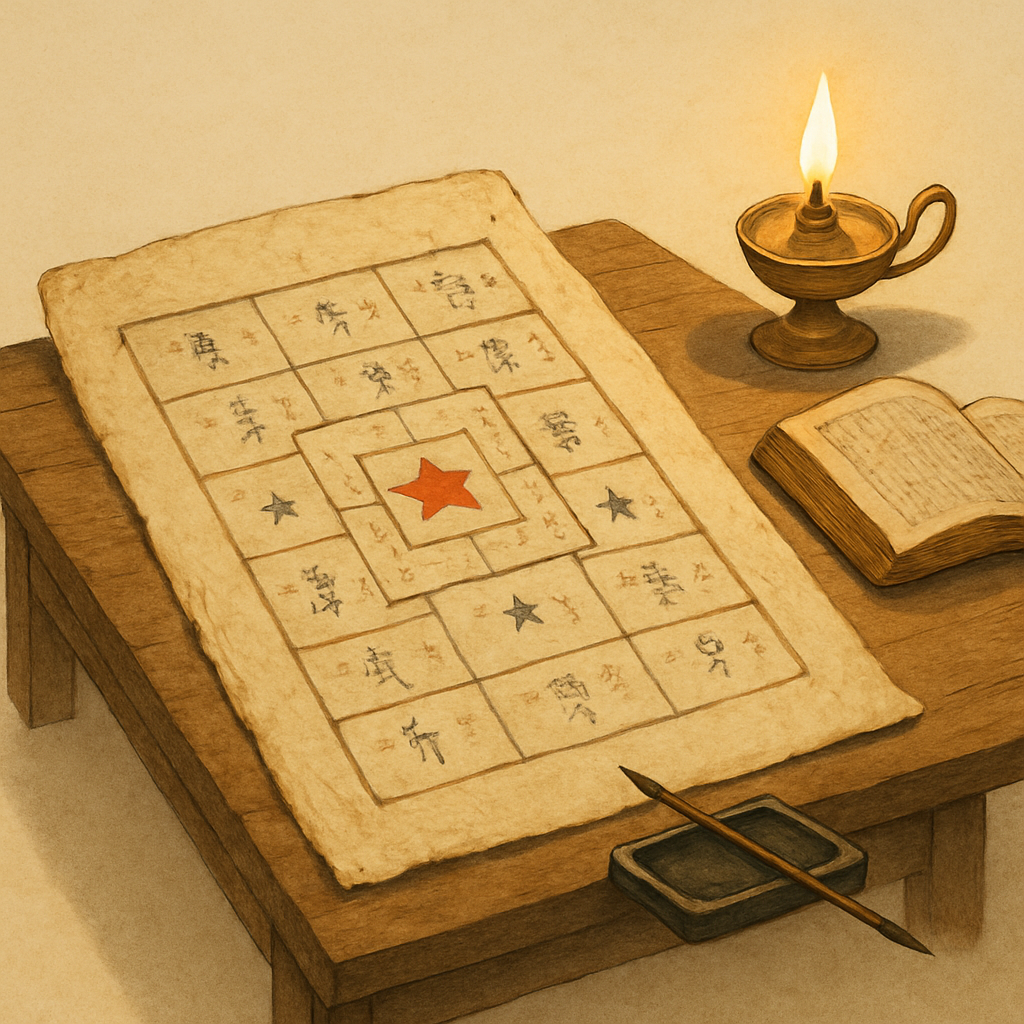
A Zi Wei Dou Shu birth chart takes the form of a square grid divided into twelve cells. Each cell is one palace, and each palace governs a specific area of life. The 12 palaces and their domains are as follows.
- Life Palace (Mingong): personality, innate temperament, and the overall direction of life.
- Siblings Palace (Hyungjeogung): relationships with siblings and close colleagues.
- Spouse Palace (Buchugung): romantic partnerships and long-term relationships.
- Children Palace (Janyeogung): relationships with children and creative output.
- Wealth Palace (Jaebaekgung): the flow of money and one's approach to finances.
- Health Palace (Jiraeggung): the body's energy and patterns of physical wellbeing.
- Travel Palace (Cheonieugung): movement, travel, and the external environment.
- Servants Palace (Nobokgung): subordinates, employees, and one's broader social network.
- Career Palace (Gwanrokgung): profession, career path, and social achievement.
- Property Palace (Jeoontaekgung): real estate and living environment.
- Wellbeing Palace (Bokdeokgung): inner contentment and personal sources of joy.
- Parents Palace (Bumogunng): relationships with parents and authority figures.
The 12 palaces do not sit in a fixed arrangement. The birth year and birth month together determine which palace lands in which cell of the chart. Even when two charts share the same Wealth Palace, the stars seated there will differ if the palaces fall in different cells.
The 14 Major Stars: What Fills the Chart
The 14 major stars are the core interpretive units of Zi Wei Dou Shu. Each carries its own distinct qualities and energy. They are broadly grouped into two clusters: the Northern Dipper stars and the Southern Dipper stars.
Northern Dipper Stars
- Purple Star (Jami): the Emperor star. Leadership, authority, self-regard.
- Heavenly Machine (Cheongi): the Strategist star. Analytical thinking, adaptability, change.
- Moon (Taeum): the Lunar star. Sensitivity, wealth accumulation (especially through property), and connections with women.
- Greedy Wolf (Tamrang): the Desire star. Appetite, versatility, sociability.
- Giant Gate (Geomun): the Rhetoric star. Eloquence, logical thinking, a tendency toward doubt.
- Heavenly Prime Minister (Cheonsang): the Seal star. Diligence, service, stability.
- Broken Army (Pagun): the Reform star. Transformation, drive, decisive breaks from the past.
Southern Dipper Stars
- Heavenly Harmony (Cheondong): the Blessing star. Gentleness, welfare, enjoyment.
- Military Arts (Mugok): the Wealth star. Money, decisiveness, a tendency toward solitude.
- Sun (Taeyang): the Solar star. Reputation, public life, paternal energy.
- Heavenly Treasury (Cheonbu): the Vault star. Stability, conservation, accumulation.
- Heavenly Beam (Cheonryang): the Shelter star. Moral integrity, longevity, management.
- Seven Killings (Chilsal): the General star. Drive, intensity, independence.
- Crimson Flame (Yeomjeong): the Prison star. Discipline, passion, the boundary between public and private life.
Beyond the 14 major stars, a number of supporting stars also appear on the chart, including the Left Assistant, Right Assistant, Literary Arts stars, and others. Their role is to reinforce or temper the qualities of the major stars nearby. The recommended approach is to understand the major stars first, then consider how the supporting stars modify them.
How to Read a Birth Chart: Starting from the Life Palace and Expanding Outward
When you first receive a birth chart, it can be hard to know where to begin. The basic sequence is to start at the Life Palace, move to the Opposite Palace, and then broaden your view across the Three Directions and Four Positions.
Step 1: Identify the Stars in the Life Palace
Begin by seeing which major star or stars occupy the Life Palace. The stars here most directly reveal a person's temperament and the general direction their life tends to take. If the Life Palace is empty (a so-called empty palace), there is a reading method that borrows the stars from the Opposite Palace instead.
Step 2: Check the Opposite Palace
The Opposite Palace sits directly across the chart from the Life Palace. If the Life Palace reflects your inner self, the Opposite Palace corresponds to how others perceive you from the outside. Reading both together can help you notice the gap between how you see yourself and the impression you tend to make on others.
Step 3: Expand to the Three Directions and Four Positions
The Three Directions and Four Positions refers to a cluster of four palaces: the Life Palace itself plus the two palaces that form a trine with it, and the Opposite Palace. A classic example of this cluster is the Life Palace, the Wealth Palace, the Career Palace, and the Travel Palace read together. Taking in all four at once reveals how a person's professional life, finances, and patterns of movement tend to connect and flow into one another.
Step 4: Locate Your Current Major Luck Period
Zi Wei Dou Shu traces the passage of time through the Major Luck Periods (daehaan), each spanning roughly ten years. During each period, one palace on the chart temporarily functions as the Life Palace for interpretation purposes. Identifying which Major Luck Period you are currently in can help you get a sense of the qualities and tendencies of the phase you are moving through right now.
A Starting Point for First-Time Readers
It is fair to say that Zi Wei Dou Shu comes down to understanding the qualities of each star, the domain of each palace, and how the two combine. For beginners, the best place to start is getting familiar with the qualities of all 14 major stars, and then reading deeply into whichever star sits in your own Life Palace.
Rather than trying to take in the whole chart at once, the fastest way forward is to understand the Life Palace thoroughly, then slowly widen your view to the palaces around it.
Zi Wei Dou Shu is a vast system, but knowing the reading sequence lowers the barrier to entry considerably. Mastering just four steps, checking the Life Palace, comparing it with the Opposite Palace, expanding across the Three Directions and Four Positions, and identifying your current Major Luck Period, gives you a solid foundation for reading any chart.
The Sajagung Zi Wei Dou Shu service lays out the major star placements and Major Luck Period flow from your personal chart. It is designed so that even someone opening their first chart can work through it at their own pace. If you are curious, it is worth a look.