Concept
Gongmang Explained: What Emptiness Means in Korean Saju
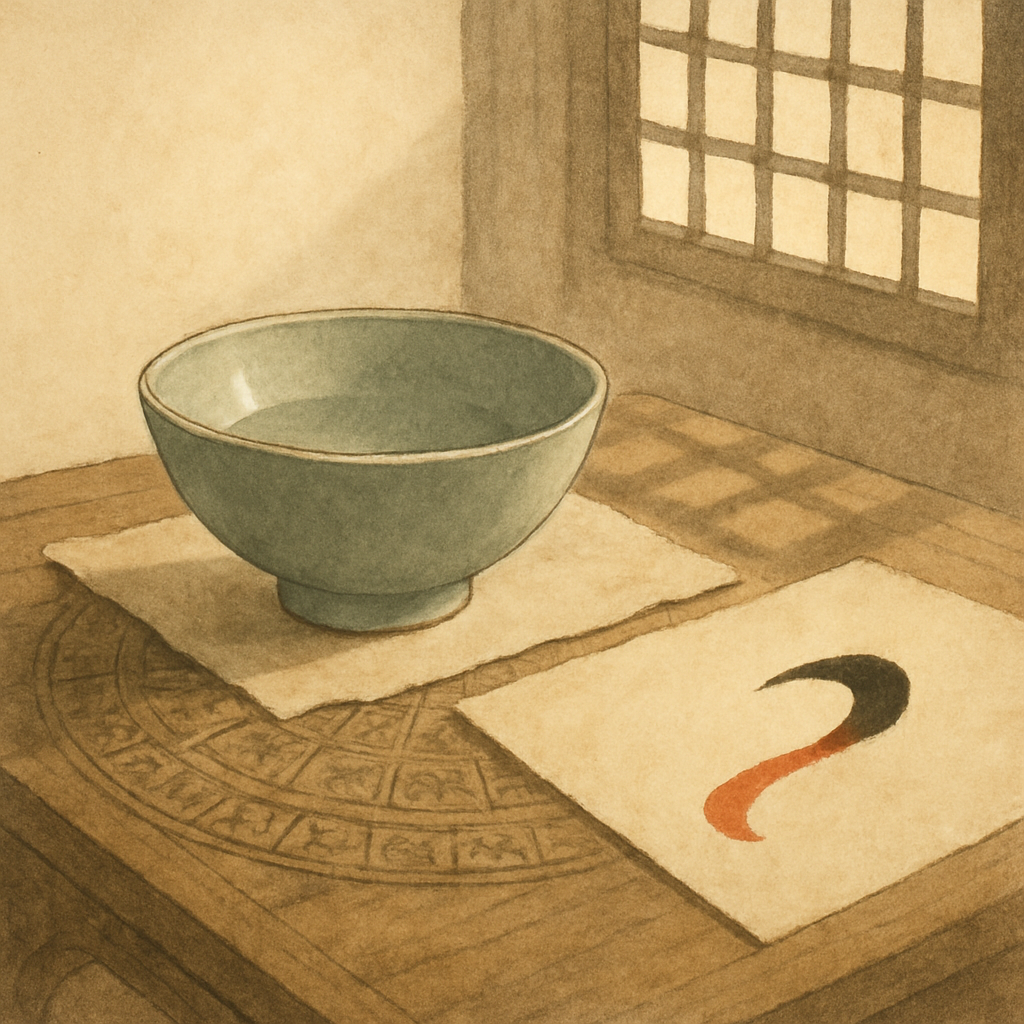
Emptiness does not have to mean lack. Just as a vessel must be empty before it can hold anything, gongmang (the empty-and-lost positions) in Saju (Korean Four Pillars astrology) does not point to absence so much as to a space that may be filled in a different way. In this post we walk through what gongmang is, how to find it, how it reads across each of the four pillars, and how it can sometimes open into something richer.
What Gongmang Is: The Pillar Left Without a Partner
Read character by character, gongmang (空亡) means 'empty (空) and gone (亡)'. In Four Pillars astrology, gongmang refers to the vacant positions that arise because the earthly branches outnumber the heavenly stems by two.
There are ten heavenly stems and twelve earthly branches. When the 60-cycle calendar is divided into groups of ten, called sun (旬, a decade-cycle), two earthly branches in each group are left without a matching stem. Those two unpaired branches are the gongmang positions for that group.
Gongmang is not a flaw. It is simply an unpaired space that arises naturally from the way the heavenly stems and earthly branches come together.
For example, in the Gapja decade-cycle (covering Gapja through Gyeyu), the branches Sul and Hae are the gongmang positions. The most common approach is to identify which decade-cycle your day stem belongs to, and gongmang is one of the concepts you cannot overlook when reading the overall pattern of a Saju Four Pillars chart.
Finding Your Gongmang in the 60-Cycle Calendar: Once You See the Structure, It Becomes Clear
The 60-cycle calendar runs from Gapja through Gyehae, forming sixty pairs divided into ten decade-cycles. Each decade-cycle begins with the same first heavenly stem, and the two earthly branches not included in that cycle become its gongmang positions.
- Gapja cycle (Gapja through Gyeyu): Sul and Hae are gongmang
- Gapsu cycle (Gapsu through Gyemi): Sin and Yu are gongmang
- Gapsin cycle (Gapsin through Gyesa): O and Mi are gongmang
- Gapo cycle (Gapo through Gyemyo): Jin and Sa are gongmang
- Gapjin cycle (Gapjin through Gyechuk): In and Myo are gongmang
- Gapin cycle (Gapin through Gyehae): Ja and Chuk are gongmang
Find which decade-cycle your day stem belongs to, then compare that cycle's two gongmang branches against the earthly branches in your four pillars. Which pillar carries a gongmang branch shapes the focus of the reading.
Which Pillar Is Empty: How Gongmang Reads Across the Four Pillars
In Four Pillars astrology, the four pillars, namely the year, month, day, and hour pillars, are each read as a domain: ancestral roots and parents, youth and siblings, the self and a partner, and children and later life. A pillar that carries a gongmang branch is seen as a space where the energy of that domain may not fully take form.
Year Pillar Gongmang: A Sense of Shifting Roots
When the year branch falls on a gongmang position, the bond with ancestors or parents may feel thin, or there may be a tendency to leave home early. Rather than putting down deep roots in one place, a person with this pattern may build their own sense of home by moving across a broader landscape.
Month Pillar Gongmang: A Scattering of Direction in Youth
The month branch is among the strongest positions in a Saju chart. When it falls on a gongmang position, the path toward a career or social role may branch off in several directions. Rather than running steadily along one track, a person with this pattern often gravitates toward exploring many different possibilities.
Day and Hour Pillar Gongmang: Absence in the Closest Relationships
A gongmang day branch is often read as a lighter bond with a partner, or a life in which solitary time naturally increases. A gongmang hour branch may suggest a more distant relationship with children, or a later life in which a person builds their own support rather than relying on others. That said, all of these readings point to tendencies and possibilities, not fixed outcomes.
When Emptiness Becomes a Doorway: The Sublimation of Gongmang
Within the long tradition of Four Pillars astrology, there has always been a perspective that refuses to read gongmang as simple lack. It is no coincidence that people with strong gongmang placements are often noted for walking paths in religion, philosophy, the arts, or scholarship.
A position that never finds its worldly counterpart can sometimes open toward a wider world instead. Just as an empty stalk in an autumn field carries the sound of the wind more clearly, a gongmang position often shows a greater openness to spiritual depth than to material satisfaction.
Because it is empty, it can receive. The void in a gongmang position is not deprivation; it is room to be filled in a different way.
When the wealth stars (财星, jaeseong) or authority stars (官星, gwanseong) fall on gongmang positions in particular, the pull toward inner exploration or creative work can become stronger than the pull toward money or status. Practitioners call this the 'sublimation' of gongmang, and it is one of the more positive readings in the classical tradition.
When Gongmang Stirs in a Major or Annual Luck Cycle
Gongmang is a fixed feature of the chart from birth, but when a major luck cycle (大運, daewoon) or annual luck cycle brings in the very branch that corresponds to your gongmang, that emptiness may ease for a time. This is sometimes called 'gongmang chung' (沖, a collision that stirs the position), and it can be read as a period when the empty space either begins to fill or, at other times, becomes more pronounced.
Some practitioners also hold that when a gongmang branch is drawn into a triple or directional combination, its effect weakens. This is one reason why looking at a single character in isolation matters less than seeing how it fits within the whole structure.
Rather than focusing too narrowly on gongmang alone, the deeper understanding comes from seeing what role it plays within the overall flow of your yongsin (用神, the favorable element) and the elements that work against you.
Closing Thoughts: The Story That Lives in the Empty Space
Gongmang is not something to fear. It is a naturally occurring gap within the structure of the 60-cycle calendar, and how that gap comes to be filled depends on the direction a person chooses and the life they build.
To see gongmang clearly, you need to know which pillar carries it, which of the ten gods (十神, the relational star types) it touches, and how it meets the flow of your luck cycles. A partial view rarely tells the whole story; reading the chart as a whole is what brings gongmang into focus.
If you are curious about where your gongmang falls and how it may be showing up in your life, a full Saju Four Pillars reading can help you see it within the context of the whole chart. Sometimes the most unexpected stories begin in the places we thought were empty.