Concept
The Eight Gates of Gi-mun Dun-gap: Open Doors and Closed Ones
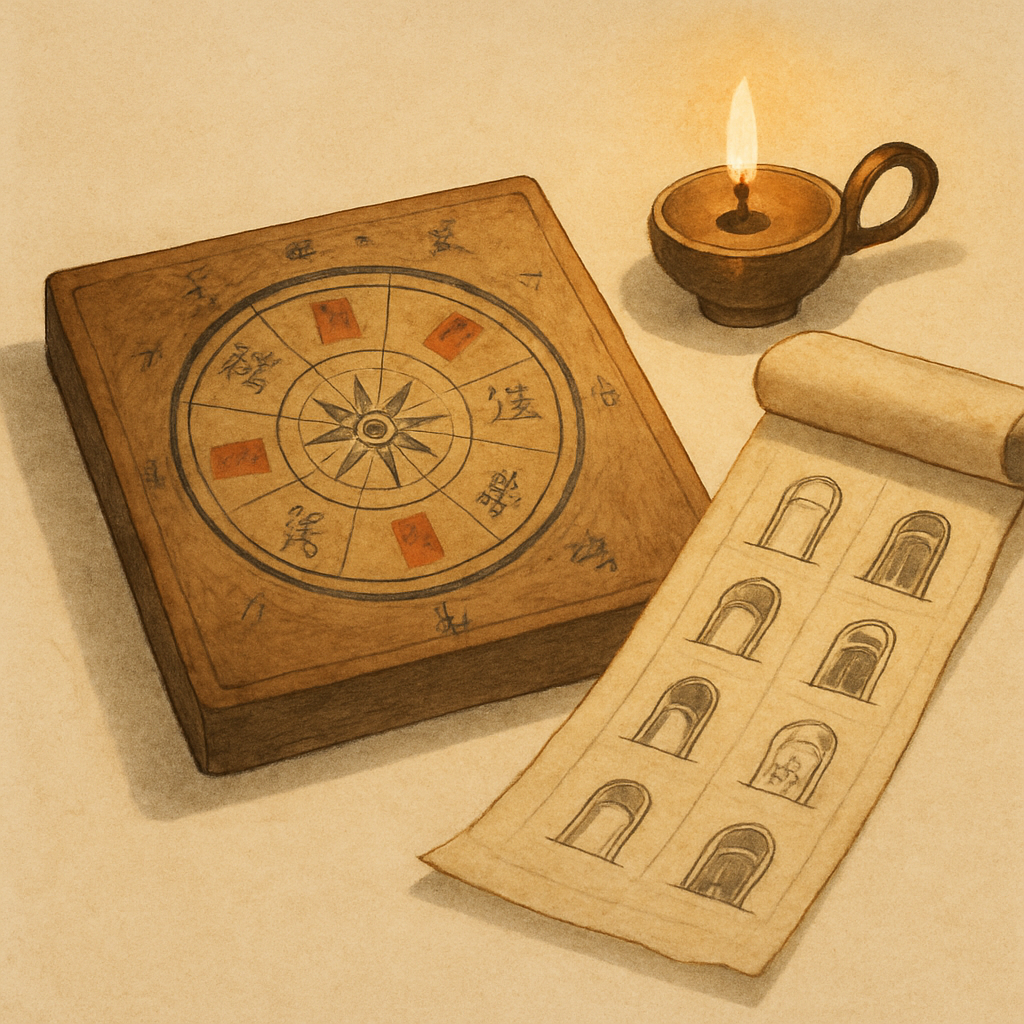
Gi-mun Dun-gap (奇門遁甲, a classical East Asian system for reading time and space together) works by layering a time reading over a spatial grid. At the heart of that system sit the Eight Gates. These eight gates are placed across the Nine Palaces grid, and they serve as guides for choosing which direction to move in and which energetic doorway to step through. This article walks through each gate's name and character, how they are classified by favorable or cautionary quality, and how to use directional readings in everyday decisions.
What Are the Eight Gates: Eight Passages That Open Space
In Gi-mun Dun-gap, a "gate" is not simply a doorway. It refers to the flow of energy that forms at a particular moment and in a particular direction.
Each of the eight gates has its own name and character, and each is placed in one of eight cells on the Nine Palaces grid. The remaining cell, the center palace (the fifth palace), holds no gate.
In short, the Eight Gates are the key indicators that tell you what quality of energy is active in a given direction at a given moment.
Names and Characters of the Eight Gates: A Quick Reference for Favorable and Cautionary Signs
The eight gates are grouped into favorable gates, cautionary gates, and neutral gates according to their character. Start by getting familiar with each name and its core meaning.
Three favorable gates: doors that support movement
- Life Gate (生門, Saeng-mun): the flow of vitality and growth. Often used when starting a business, looking for work, or moving home.
- Open Gate (開門, Gae-mun): the flow of breakthrough and expansion. Points toward directions that tend to favor contracts, negotiations, and departures.
- Rest Gate (休門, Hyu-mun): the flow of recovery and stability. A good match for recuperation, rest, and quietly consolidating what you have.
Two context-dependent gates: meaning shifts with the situation
- Scenery Gate (景門, Gyeong-mun): the flow of documents, reputation, and visibility. Can be positive for promotion and examinations, but calls for care when a dispute is already underway.
- Obstruction Gate (杜門, Du-mun): the flow of blockage and withdrawal. Useful when keeping a low profile, but not well suited to active outward moves.
Three cautionary gates: directions to slow down or avoid
- Injury Gate (傷門, Sang-mun): the flow of conflict, clashes, and harm. Worth watching when this gate appears in a direction associated with legal disputes or confrontations.
- Death Gate (死門, Sa-mun): the flow of stagnation and dissolution. When it falls in the direction of an important journey or new beginning, avoiding that direction is generally advisable.
- Shock Gate (驚門, Gyeong-mun): the flow of surprises and sudden variables. The likelihood of unexpected events tends to be higher when this gate is active.
To sum up: the basic principle is to actively seek out the Life, Open, and Rest gates, and to avoid the Death and Injury gates when choosing a direction for travel.
The Nine Palaces Grid: How the Eight Gates Shift Position
The Nine Palaces is a 3×3 spatial grid. Each cell carries a direction and a number, and the Eight Gates move across this grid each time the reading period changes.
For example, the Life Gate might be placed in the northeast cell during a particular morning period, then shift to the east cell in the next period.
Three factors determine this placement: whether the season falls under Yang Cycle or Yin Cycle (陽遁 or 陰遁), the section (元) of the current solar term, and the stems and branches of the reading period.
In short, the positions of the Eight Gates are not fixed. They change with the time and the solar term, so you always need to identify the active configuration for the specific moment you are looking at.
Using the Three Favorable Gates: Three Situations for Life, Open, and Rest
Using a favorable gate is straightforward. At the relevant time period, you act toward, or set your route in the direction of, whichever cell holds the gate you need.
When to choose which gate
- Starting something new, or heading into a contract or interview: use the Life Gate or Open Gate direction as your point of departure.
- Recovering your energy or preparing quietly: rest in the direction of the Rest Gate, or use a space that lies in that direction.
- Submitting documents, presenting, or running a promotion: the Scenery Gate direction can serve as a supporting choice.
Before you look for a good gate, decide what you are actually trying to do. Once your purpose is clear, the right gate tends to become obvious.
To sum up: use the Life, Open, and Rest gates according to your specific purpose. All three are favorable, but that does not mean they are interchangeable across every situation.
Avoiding the Death and Injury Gates: A Checklist for Cautionary Directions
Avoiding cautionary gates makes up the other half of working with the Eight Gates. It is especially worth checking when you are about to put real energy into an action, such as traveling, signing a contract, or starting something new.
Three moments when checking cautionary gate directions matters
- Just before departing on an important long-distance journey: check whether the Death Gate or Injury Gate is placed in your direction of travel.
- When scheduling a first meeting with a potential business partner: check whether the Injury Gate or Shock Gate is open in the direction of the other party.
- When deciding the direction for a home move: if the Death Gate falls in the direction of your intended destination during a given period, avoiding that period is generally worth considering.
A direction that holds a cautionary gate is not permanently unfavorable. Once that time period passes, the configuration changes.
To sum up: avoiding a cautionary gate means avoiding that direction at this particular moment, not avoiding it forever.
Mapping Your Route by Time Period: Connecting the Eight Gates to Everyday Life
Working with the Eight Gates in practice comes down to three steps. First, settle on the time period for your action. Second, identify the active Gi-mun configuration for that period. Third, confirm the favorable gate direction that fits your purpose and plan your route accordingly.
The Gi-mun Dun-gap direction reading makes it easy to check the Eight Gates placement for any solar term and time period. You can see the favorable and cautionary flow by direction without having to calculate the configuration yourself.
A step-by-step order for planning your route
- Step 1: Clarify your purpose. Are you traveling somewhere, starting something, or recovering?
- Step 2: Fix the time period. Settle on a specific date and time window for your action.
- Step 3: Check the Eight Gates placement for that period. See which gate sits in which direction.
- Step 4: Adjust your departure direction or destination to align with a favorable gate.
- Step 5: If part of your route overlaps with a cautionary gate direction, shift the time or take a detour.
To sum up: using the Eight Gates means choosing the moment and direction when a good gate is open. It is not about changing your fate. It is about choosing a flow that works in your favor.
The Eight Gates are not a compass. They do not tell you which way to go. They tell you whether the way you are considering is open or closed right now.
If you want to see how the Eight Gates are arranged by solar term and time period, check the Gi-mun Dun-gap direction reading now.