Concept
What Are Yin-Yang and the Five Elements? The Foundations of Korean Four Pillars Astrology
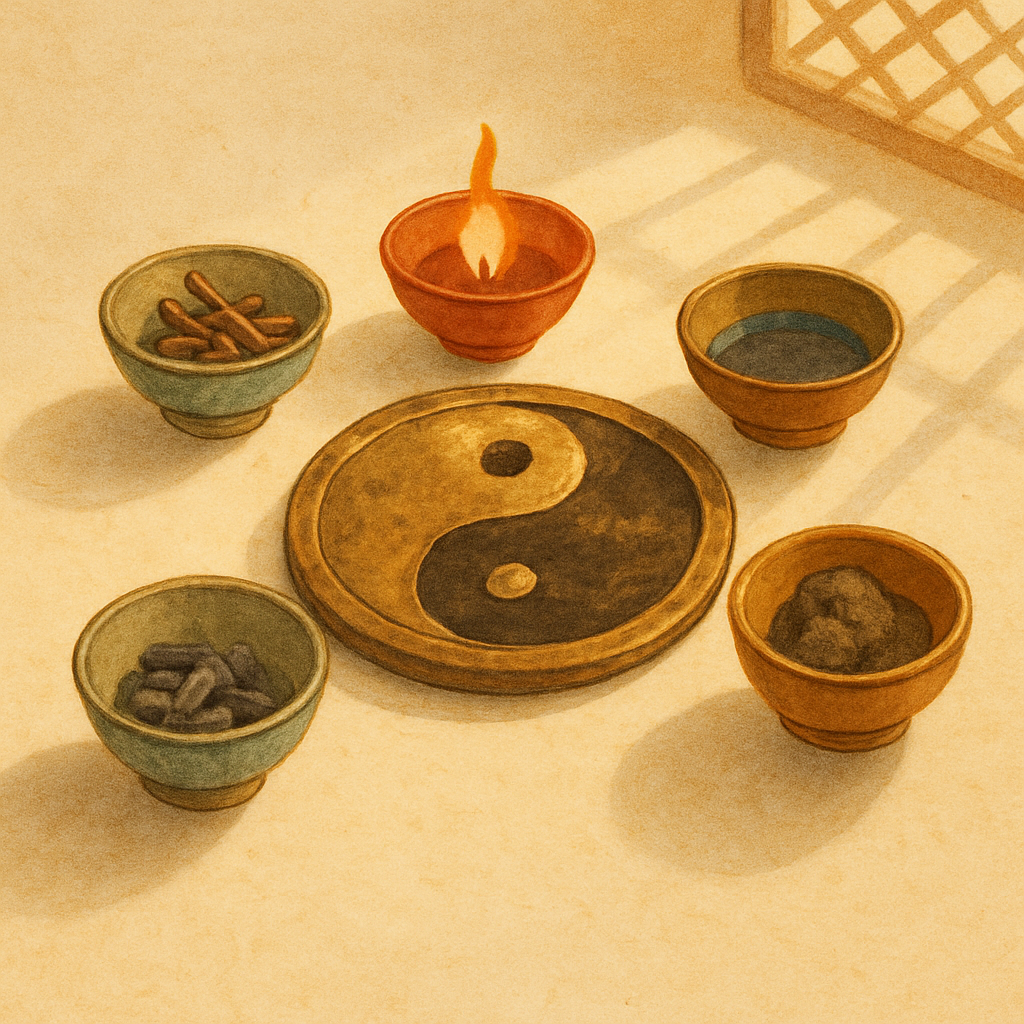
An old current of East Asian thought holds that everything in the universe begins as a conversation between two forces. As yin and yang push and pull against each other, five distinct energies emerge, and those energies circulate like seasons, quietly shaping the texture of a human life. The roots of Saju (Korean Four Pillars astrology) grow directly from this soil: the worldview known as yin-yang and the five elements (陰陽五行, yin-yang and the five elemental energies).
Why Yin-Yang and the Five Elements? How Korean Astrology Reads the World
When you first peer into the study of Korean astrology, a flood of unfamiliar characters and terms can make it hard to know where to begin.
Yet if you peel back the layers of that vast system one by one, a spare and sturdy framework remains at the very bottom. That framework is the worldview of yin-yang and the five elements.
Yin-yang and the five elements are not simply tools of divination. They represent a philosophy of nature, a language of patterns that people across ancient East Asia developed by closely watching how the natural world changes. It is an intuition, carefully refined over centuries, that the world flows in constant cycles, just as day follows night and summer follows spring.
When the way you understand the world shifts, the way you understand yourself shifts too.
Yin and Yang: The Rhythm of Two Forces That Move the World
Yin and yang are the first concepts to understand. They point to two qualities that are opposite yet mutually dependent, like light and shadow, day and night, activity and rest.
Yang is bright, warm, and rising; yin is quiet, cool, and gathering. But these two are not enemies. Just as the sunny southern slope and the shaded northern slope together make one mountain, yin and yang only become complete when they exist alongside each other.
- Yang: heaven, daytime, fire, outward and active energy, expansion, movement
- Yin: earth, nighttime, water, inward and receptive energy, gathering, stillness
In a Four Pillars chart, each of the Heavenly Stems and Earthly Branches carries either a yin or a yang quality. The stems that fall in odd positions, Gab, Byeong, Mu, Gyeong, and Im, are yang, while Eul, Jeong, Gi, Sin, and Gye are yin. The interplay of yin and yang across a chart is the first clue to its overall temperature and direction.
The Five Elements: Five Faces of a World That Circulates Like the Seasons
Where yin and yang divide the world into two directions, the five elements (五行, the five elemental energies) break it down further into five distinct qualities: Wood, Fire, Earth, Metal, and Water.
The character of each element
- Wood: the energy of spring. A life force that stretches and grows upward. Associated with beginnings and creativity.
- Fire: the energy of summer. A passion that radiates outward and spreads light. The energy of expression and connection.
- Earth: the energy of seasonal transitions. A grounding center that holds and encompasses. Carries the power of harmony and mediation.
- Metal: the energy of autumn. A refining, condensing force. Associated with decisiveness and principle.
- Water: the energy of winter. A deep, gathering, flowing quality. Holds wisdom and latent potential.
The five elements are not simply names for things found in nature. Each one connects to organs of the body, cardinal directions, colors, emotions, and phases of life. By observing which elements are strong or weak within a Four Pillars chart, a reader can draw rich meaning about a person's temperament and the likely currents of their life.
Generation and Control: How the Five Elements Help and Check One Another
The five elemental energies do not sit still. They are constantly in relationship, nurturing one another in one direction and checking one another in another. These are the principles of generation (相生, each element feeding the next) and control (相剋, each element restraining another).
Generation: the flow in which energies nourish each other
- Wood feeds Fire (wood fuels a flame)
- Fire feeds Earth (fire burns down and its ash enriches the soil)
- Earth feeds Metal (minerals form and mature within the earth)
- Metal feeds Water (moisture condenses on a metal surface)
- Water feeds Wood (water helps trees grow)
Control: the flow in which energies check each other
- Wood controls Earth (tree roots push down into the ground)
- Earth controls Water (soil contains and redirects water)
- Water controls Fire (water extinguishes fire)
- Fire controls Metal (fire melts metal)
- Metal controls Wood (an axe cuts through wood)
Control is not inherently a bad thing. Without it, one element could grow so dominant that balance collapses. Just as a well-timed spring rain helps a tree grow strong rather than waterlogged, the right degree of tension can often make a life more resilient.
How Yin-Yang and the Five Elements Work Inside a Four Pillars Chart
A Four Pillars chart records the year, month, day, and hour of a person's birth as two characters each, producing eight characters in total. Every one of those eight characters belongs to one of the five elements and carries either a yin or a yang quality.
When a chart unfolds with a great deal of Wood, there tends to be a strong creative and pioneering temperament. Yet if Metal is absent to provide a check, the pattern may lean toward abundant ideas without consistent follow-through. A chart with very vigorous Fire can radiate energy that lights up those around it, but when Water is not there to balance it, a pattern of burning out too quickly can sometimes appear.
Korean astrology reads the relative strength of the five elements and the balance of yin and yang across those eight characters to explore a person's natural temperament and to identify which energies may serve as resources and which may benefit from a little more attention.
Reading a Four Pillars chart is not about fixing fate. It is about surveying the terrain of the energies that flow within you.
Standing at the Entrance: What Changes Once You Understand Yin-Yang and the Five Elements
Once you grasp the basics of yin-yang and the five elements, the rest of Korean astrology tends to feel suddenly more familiar. Terms like the ten relational spirits or the favorable element (用神, yongsin) turn out to be, at heart, just different ways of naming relationships among the five elements.
The rhythms of generation and control can also serve as a loose metaphor for relationships between people, the movement of projects, and the ups and downs of wellbeing. Carrying that framework quietly in the back of your mind may gradually shift how you approach periods that feel easy and periods that feel heavy.
Yin-yang and the five elements do not offer definitive answers. They are more like an additional lens, an old and thoughtful way of looking at the world and at yourself. If you would like to use that lens to look at your own energies directly, we invite you to open your own chart at Four Pillars. The elemental story held within those eight characters may have more to say, quietly, than you might expect.