Concept
How to Cast a Coin Reading: The Structure of the 64 Hexagrams
The moment you cup three coins in your palm and give them a light shake, you are picking up a thread of inquiry that people have cast toward heaven and earth for thousands of years. Coin divination is not a simple fortune game. It is the I Ching's (周易, the Book of Changes) own way of thinking: layering the flow of yin and yang across six levels to form a living image. Today we will walk through that structure slowly, for those encountering it for the first time.
Why Three Coins?
In ancient China, divination was performed by sorting 49 stalks of yarrow (蓍草, shicao) by hand. The process was intricate and time-consuming, so later generations developed a simpler method using three coins, which gradually became the standard.
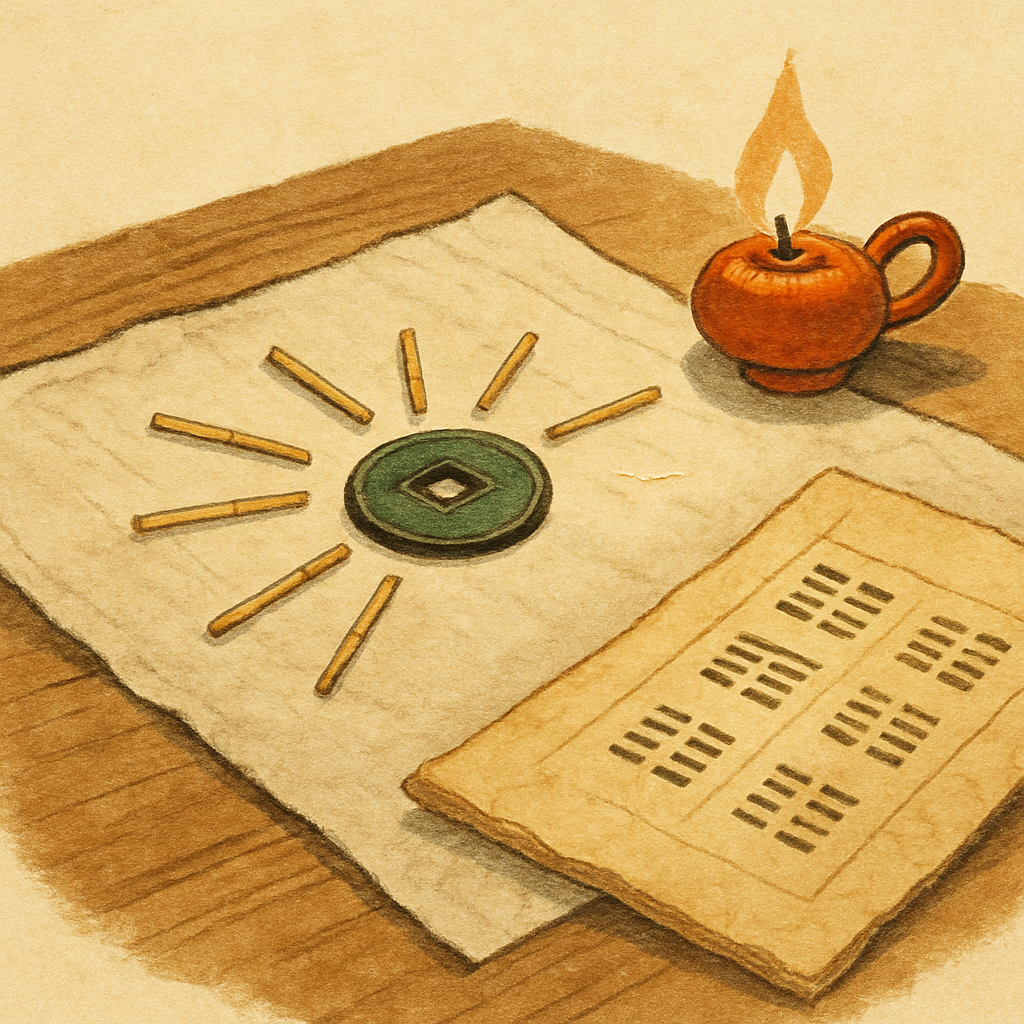
Each coin carries two possibilities: heads and tails, or yang (light) and yin (dark). Toss all three at once and you get a combination of heads and tails that determines a single line, called a yao (爻, line), which is the building block of every hexagram. This straightforward principle is the starting point for the entire I Ching.
The three coins do not create an outcome. They are a tool for reading the energy that is already moving through this particular moment.
How a Single Line Is Determined
The standard convention assigns heads a value of 3 and tails a value of 2. When you toss three coins, the total can only be 6, 7, 8, or 9.
- Total 6: Old Yin (broken line, -- ). A moving line that may transform.
- Total 7: Young Yang (solid line,, ). Stable yang.
- Total 8: Young Yin (broken line, -- ). Stable yin.
- Total 9: Old Yang (solid line,, ). A moving line that may transform.
Old Yang (9) and Old Yin (6) are what the tradition calls dong yao (動爻, moving lines). Because they carry the most charged energy, they flip: a yang moving line becomes yin, and a yin moving line becomes yang, generating a second hexagram. It is rather like a midsummer afternoon so intensely hot that a downpour finally breaks through. Energy at its peak tends to change direction.
Six Tosses Complete a Hexagram
Once you have your first line, repeat the process five more times. The first line you obtain goes at the very bottom of the hexagram, and the sixth line sits at the top. That order, building from the bottom up, matters: it mirrors the movement from earth toward heaven, from the present toward what may come.
When all six lines are in place, you have your ben gua (本卦, primary hexagram). The six lines are read in two halves: the lower trigram (the bottom three lines) and the upper trigram (the top three lines). There are eight possible trigrams, and eight upper trigrams multiplied by eight lower trigrams gives exactly 64 primary hexagrams.
The 64 hexagrams are combinations of eight natural forces: heaven, earth, water, fire, wind, thunder, mountain, and lake. Together they form a symbolic map broad enough to hold any human situation. I Ching divination can be thought of as the process of finding, among these 64 landscapes, the one that most closely resembles the terrain of your question right now.
Why Moving Lines Shift the Direction of an Answer
A hexagram with no moving lines describes the state of this present moment. Like a river flowing quietly today, the situation rests where it is.
When one or more lines are moving, each of those lines flips its polarity, producing an entirely different hexagram called the zhi gua (之卦, resulting hexagram). If the primary hexagram reflects the current flow, the resulting hexagram reflects where that flow may be heading. Reading both together gives a much more layered answer to your question.
- No moving lines: focus on the gua ci (卦辭, hexagram statement) of the primary hexagram.
- One moving line: the yao ci (爻辭, line statement) for that line carries the main message.
- Two moving lines: compare both line statements, giving priority to the higher of the two.
- Three or more moving lines: read the hexagram statements of both the primary and resulting hexagrams together.
Different schools interpret moving lines with slightly different conventions, but the sequence above tends to be the most approachable starting point for newcomers.
How a Beginner Can Work Through a Reading
Many people feel at a loss when they receive a hexagram. Try working through it in the following order, taking your time at each step.
- Step 1: Take in the name and symbol of the primary hexagram (heaven, water, mountain, and so on). The name alone can reveal the broad shape of the situation.
- Step 2: Read the hexagram statement aloud. Before analyzing it, simply sit with its atmosphere.
- Step 3: If there are moving lines, read the corresponding line statements. Line statements often carry concrete hints about action.
- Step 4: If a resulting hexagram has appeared, read its name and hexagram statement as the direction things may move toward after the present moment.
- Step 5: Return to your original question and, in your own words, piece together the story the two hexagrams are telling.
A hexagram is not an answer sheet. It is closer to a mirror that lets you see which current you are standing in right now. The more you read, the more clearly the direction each hexagram points will tend to come into focus.
If You Would Like to Work Through a Reading Together
Once you understand the structure of coin divination, the natural next step is to cast a hexagram and read it yourself. The symbolic language of the 64 hexagrams can be difficult to interpret on your own. If you find yourself losing your bearings, Sajagung's I Ching divination service is here to help you work through the current flow together.
A hexagram does not pronounce a verdict. It quietly shows you which crossroads you are standing at in this moment.
Taking the time to look at that landscape with an unhurried eye may be the most valuable way to work with I Ching divination.