Concept
The Ten-Year Major Cycle: The Great River Running Through Your Saju
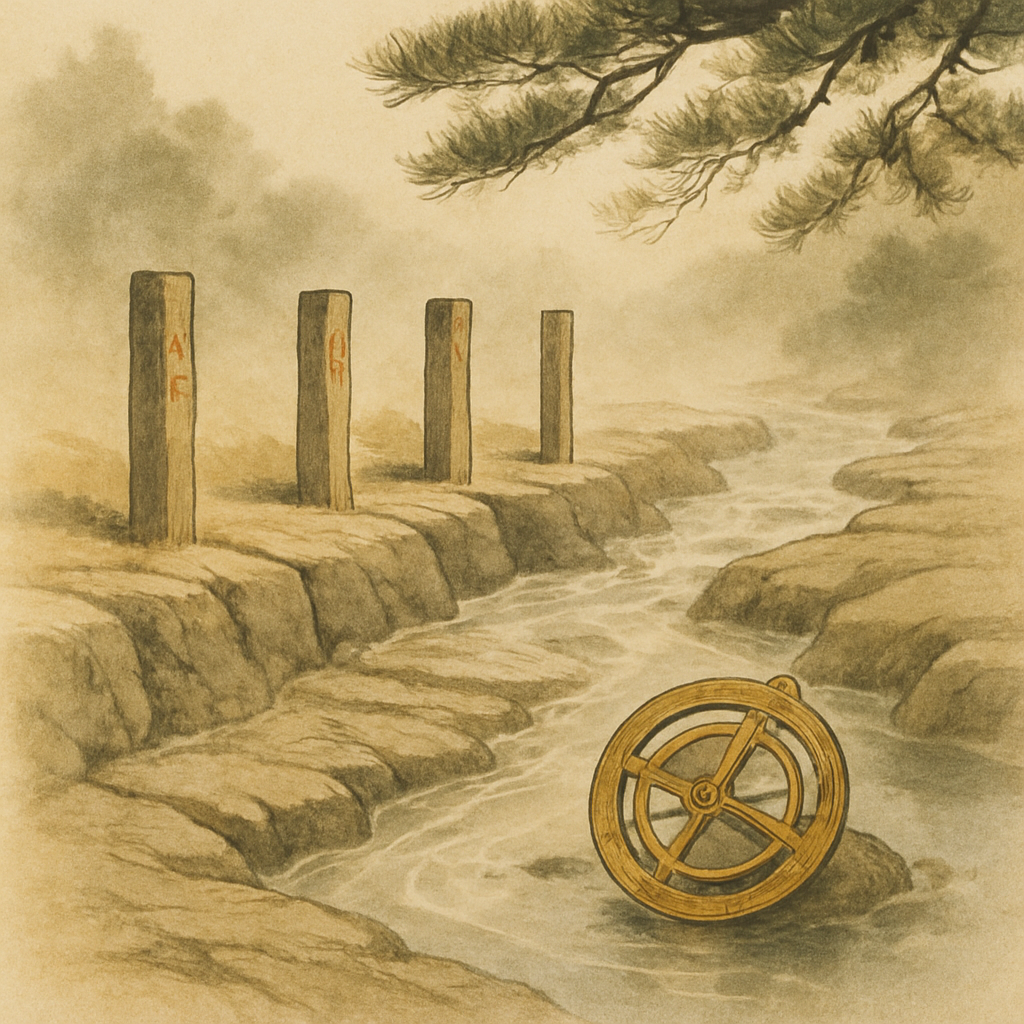
A river is always moving. Sometimes wide and gentle, sometimes narrow and swift. In Saju, the major cycle called daeun works like the gradient of that river. If your eight birth characters are the landscape, the major cycle is the direction of the current shifting every ten years. When you understand the flow, you can sense when to row hard and when to rest.
What the Major Cycle Is: Seasons Moving Across a Fixed Map
Saju (Korean Four Pillars astrology) records the year, month, day, and hour of your birth as eight characters, two for each pillar. Those eight characters never change. Yet life is always changing. Classical Korean astrology developed the concept of the major cycle to account for that movement.
The major cycle uses the month pillar (the two characters representing your birth month) as its starting point, then advances one stem-and-branch column every ten years. Put simply, it is a sequence of ten-year seasons flowing across the fixed score of your Saju. Just as the same piece of music feels different played in spring versus winter, the same Saju can carry a very different texture depending on which major cycle you are standing in.
Saju is the terrain. The major cycle is the direction of the current flowing across it.
How to Calculate the Major Cycle: Forward and Reverse Progressions
The direction the major cycle moves depends on the heavenly stem of your birth year (whether it is a yang or yin stem) and your gender. In traditional practice this is called the forward progression for yang-stem men and yin-stem women, and the reverse progression for yin-stem men and yang-stem women.
- Men born in a yang-stem year, women born in a yin-stem year: the major cycle is drawn by moving forward through the solar terms from the month pillar.
- Men born in a yin-stem year, women born in a yang-stem year: the major cycle is drawn by moving backward through the solar terms.
- The starting age (the major cycle number) is found by counting the days between the birthday and the nearest solar term, then dividing by three.
If that number comes out to three, the first major cycle begins at age three. From there it shifts every ten years: at thirteen, twenty-three, thirty-three, and so on. Like the needle of a compass turning, the compass of time advances one step at a time.
Five Years of Stem, Five Years of Branch: Two Movements Within One Cycle
The standard approach is to read each ten-year major cycle in two halves. The heavenly stem governs the first five years, and the earthly branch governs the second five.
The heavenly stem carries the expressed energy of the five elemental phases (wood, fire, earth, metal, water), reflecting events and shifts in relationships that play out on the surface of life. The earthly branch carries the energy of the ground beneath, pointing to deeper internal changes such as shifts in constitution or psychological undercurrents.
Think of it as five years of spring rain falling, followed by five years of that rainwater soaking into the soil to reach the roots. Visible change and quietly accumulating change unfold together.
Meeting the Favorable and Unfavorable Elements: When the Current Changes
One of the core tasks in reading Saju is identifying the yongsin (the favorable element, the elemental phase your chart needs most) and the gisin (the unfavorable element, the phase that tends to disturb the chart's balance).
When a major cycle brings in the favorable element, it can feel like water finally reaching a dry paddy field. Effort is more likely to bear fruit, and relationships may ease. When a cycle carries a strong unfavorable element, it tends to be like rowing into a headwind: the same effort may take more out of you.
The important thing is that a cycle dominated by the unfavorable element does not mean things will necessarily be hard. A sailor who knows the headwind is blowing does not lose direction. Simply understanding the current is itself a form of preparation.
Layering in the Annual Cycle: Small Waves on a Great River
The annual cycle (seun) is the stem-and-branch pair that changes each calendar year. If the major cycle is the great river running for ten years, the annual cycle is the individual waves passing across it year by year.
The same annual cycle can feel very different depending on which major cycle it falls inside. When both the major cycle and the annual cycle carry the favorable element, the energy of that year tends to feel especially clear and strong. When an unfavorable annual cycle arrives inside an already unfavorable major cycle, even small waves can seem larger than usual.
Reading the major cycle and the annual cycle together is a bit like checking both a map and a weather forecast at the same time. The map alone cannot tell you today's conditions, and the forecast alone cannot tell you where you are going. Only when you overlay the two does your current position come into focus.
- Combinations and clashes between the major cycle stem and the annual cycle stem: possible shifts in social events and interpersonal relationships during that year.
- Three-harmony combinations and clashes between the major cycle branch and the annual cycle branch: inner psychological changes, as well as patterns around health or change of residence.
- Years when the favorable element appears in both cycles: a period when things you have prepared may be more likely to come to fruition.
Reading the Current: Walking With the River
Knowing your major cycle does not fix the future in place. It simply tells you the direction of the current so you can choose how to steer. Saju is not a system that pronounces verdicts on fate. It is a practical wisdom tool for reading the texture of time and making more considered choices.
Start by asking which elemental phase your current major cycle carries and whether it leans toward your favorable or unfavorable element. That one question is the first step toward reading the shape of the next ten years.
There is no need to fight the current. Once you know the direction, even the river can become a companion.
If you are curious about how your own major cycle flows, try a Saju reading to see directly which current you are standing in right now. Having a ten-year map in hand turns out to be a steadier feeling than you might expect.